Bertel Thorvaldsen
1770–1844 · Kingdom of Denmark · Neoclassicism
The story
In the spring of 1803 a young Danish sculptor in Rome, the son of an Icelandic woodcarver from the Copenhagen shipyards, was packing to go home. His travel grant from the Copenhagen Academy, the royal art school he had entered at eleven, had run out. He had modelled Jason, the Greek hero carrying the Golden Fleece, in clay twice, and Antonio Canova, then the leading sculptor in Rome, had praised it, yet no buyer came forward. Then, almost at the last minute, the Anglo-Dutch collector Thomas Hope saw the figure in his studio and ordered it in marble. Thorvaldsen stayed. Hope, for his part, waited 25 years for the finished statue.
That reprieve became roughly 40 years in Rome. Thorvaldsen had arrived on 8 March 1797, and because no record of his birth was ever found, he kept that day as his "Roman birthday" for the rest of his life. His workshop grew large, with assistants cutting the marble from his models, and the commissions ran from the tomb of Pope Pius VII in St Peter's to a colossal Christ for Copenhagen's cathedral.
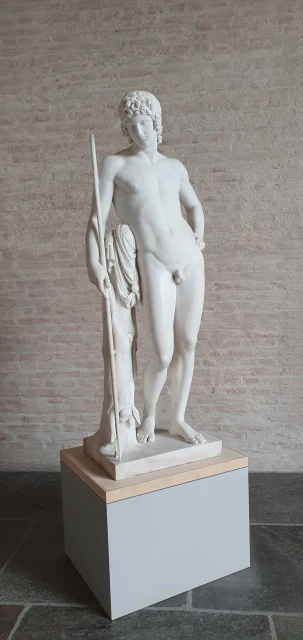
One of his most loyal patrons was Ludwig, crown prince and later king of Bavaria, the man behind Munich's Glyptothek sculpture museum. In 1808 Ludwig ordered an Adonis and insisted that Thorvaldsen carve it entirely by his own hand, which helps explain why it was finished only in 1832. In those years Thorvaldsen also restored the newly found temple figures from Aegina for him.
In 1838 the Danish king sent the frigate Rota to bring him home together with most of his works, and Copenhagen built the Thorvaldsens Museum to hold them. A painted frieze along its outer wall shows the ship's arrival in the harbour. He died suddenly in 1844 at the Royal Theatre, four years before the museum opened, and he is buried in its courtyard.