Bonaventura Berlinghieri
1210–1287 · Republic of Lucca · Gothic
The story
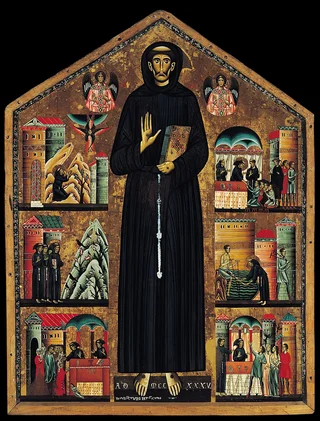
When Bonaventura Berlinghieri signed and dated an altarpiece of Saint Francis in 1235, the saint had been dead for only nine years. Francis of Assisi died in 1226 and was declared a saint two years later, so Berlinghieri was painting a holy man still inside living memory, for people who might have met him. The panel, made for the church of San Francesco in Pescia, a Tuscan town near his native Lucca, shows Francis standing tall and gaunt, displaying the stigmata, the wounds of Christ, flanked by six small scenes from his life.
Berlinghieri worked in what Italians later called the maniera greca, the Greek manner, the gold-ground Byzantine style that ruled Tuscan painting before Giotto. He came from a family of painters in Lucca. His father Berlinghiero and his brothers all worked in the same idiom. Little else about his life is documented, beyond a scatter of records placing him active from the 1220s into the 1270s.
The Pescia panel is his one securely signed work. It counts among the earliest images to tell the life of Francis as a narrative sequence, six episodes ranged around the standing saint, and it still hangs in the church it was painted for.