Brunswick Monogrammist
Habsburg Netherlands · Northern Renaissance
The story
We do not know his name. He signed himself only once, on a small panel of the Parable of the Great Supper now in Brunswick, in Germany, with a knot of interlocked letters that reads roughly as J, V, A, M, S and L, and no one has agreed on how to untangle it. So scholars call him after the monogram and the town where it hangs.
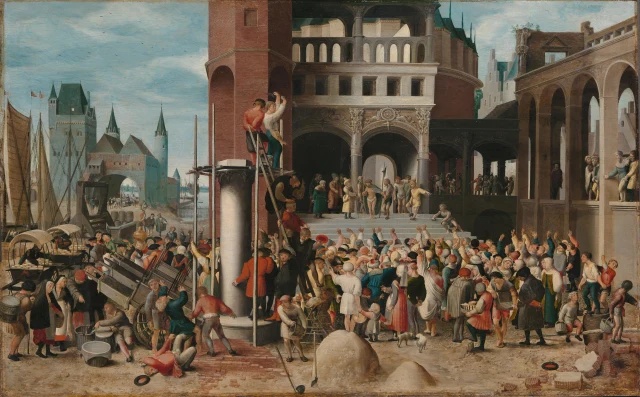
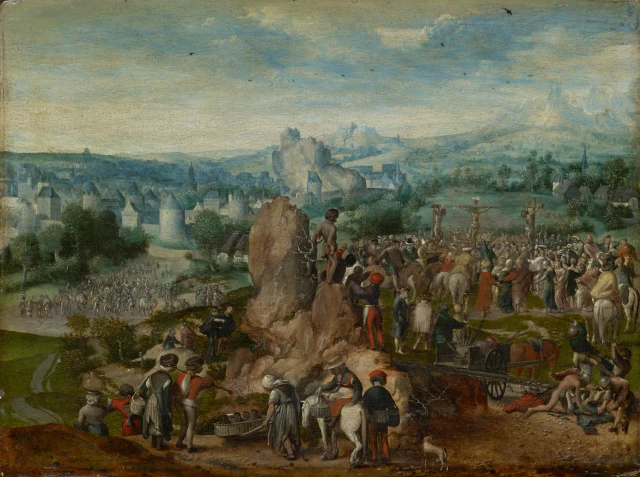
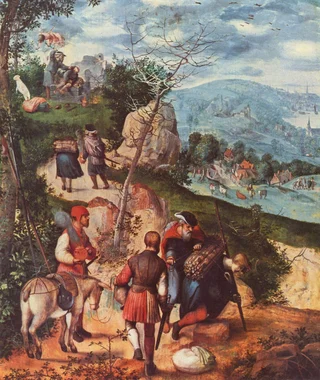
What survives is a body of work with a very particular eye. He painted religious subjects, and he also filled panels with tavern brawls, brothels and roadside crowds, small figures scattered across wide landscapes, ordinary life watched from a slight distance. That habit of turning little people loose in a broad setting made him, for many historians, the most important forerunner of Pieter Bruegel the Elder, who would do the very same thing a generation later.
The guesses about his identity have circled a few names, most persistently the Antwerp painter Jan van Amstel, and more recently Mayken Verhulst, a woman who ran a workshop and was Bruegel's own mother-in-law. None of it has been proven. He was active roughly between 1535 and 1555, and beyond those two decades of paintings he leaves no trace at all.