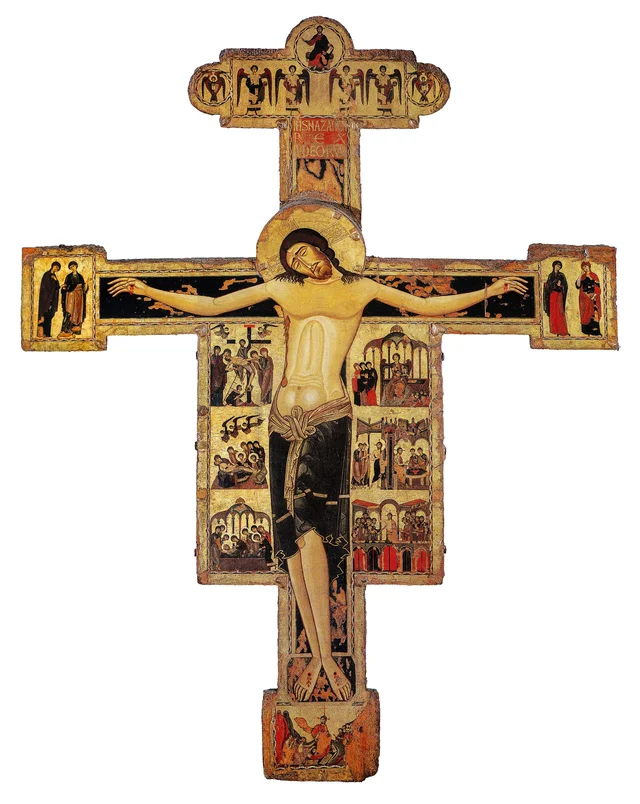
Byzantine Master of the Crucifix of Pisa
The story
The National Museum of San Matteo in Pisa keeps a large collection of painted crosses, and one of them, catalogued as Cross No. 20, stands almost three metres tall. Its painter is unknown, so art historians call him the Byzantine Master of the Crucifix of Pisa. The cross came from the Pisan monastery of San Matteo and is usually dated to the late 12th or very early 13th century, around 1210 at the latest.
Christ hangs with his head bowed and his eyes closed, blood running from his wounds. This suffering type, known as the Christus patiens, came from Byzantine art, and this cross is among its earliest appearances in Italian painting, at a time when Tuscan crosses usually showed Christ alive and upright. The master painted in tempera and gold on parchment glued to the wooden panel, a rare technique in Italy. Scholars once imagined a Greek artist who fled after crusaders sacked Constantinople in 1204. Most now place him in Pisa itself, a port with close ties to the eastern Mediterranean. Small scenes of the Passion and the Resurrection, from the Deposition to Doubting Thomas, run down both sides of the cross.