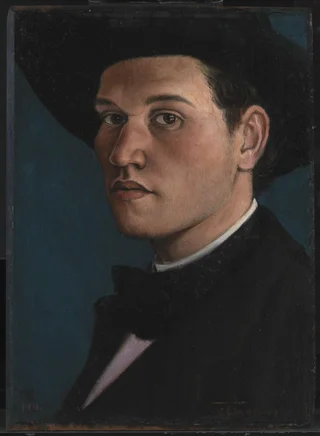
C. R. W. Nevinson
1889–1946 · United Kingdom, United Kingdom of Great Britain and Ireland · Futurism
The story
Before 1914 Christopher Nevinson believed war might be beautiful. As a young English painter he had fallen in with Marinetti, the Italian poet who ran the Futurist movement and preached the glamour of speed, machines and violence. Nevinson carried that faith home to London, and it did not survive contact with the real thing.
When war came he drove an ambulance in France for the Red Cross and saw the trenches from the inside. Out of it came La Mitrailleuse, painted in 1915, in which three soldiers are fused to their machine gun like parts of it while a fourth lies dead at their feet. The older painter Walter Sickert said it might remain the most concentrated statement on the war in the history of painting.
Two years later he became an official war artist and painted Paths of Glory in 1917, two dead British soldiers lying face down in the mud among the barbed wire. The War Office censored it, judging it bad for civilian morale. Nevinson showed it anyway at his London exhibition the following spring, a strip of brown paper pasted across the canvas reading Censored, which drew crowds and an official reprimand at the same time. The picture hangs today in the Imperial War Museum in London, the paper strip long gone, the story of its banning fixed to it ever since.
