Camille Claudel
1864–1943 · France · Symbolism, Art Nouveau
The story
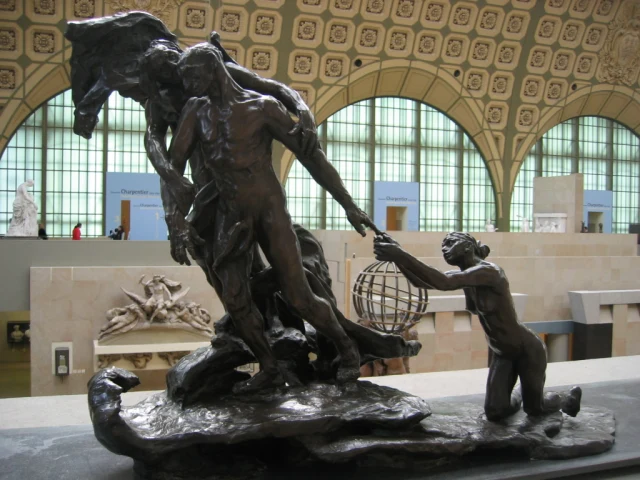
In 1895 the French State commissioned a plaster group from Camille Claudel. A young woman kneels with her arms held out, while a man turns away from her, led off by an old woman. Her brother, the poet Paul Claudel, saw his sister in the kneeling figure. Many viewers have seen Rodin, her teacher and lover, going back to Rose Beuret, his companion of many years. In 1899 the order for a bronze was cancelled just before it was signed. The Age of Maturity was cast only after a private buyer ordered it in 1902, and one bronze now stands in the Musée d'Orsay.
Claudel had entered Rodin's studio in 1883, at 19, encouraged by the sculptor Alfred Boucher. She worked on his commissions, was trusted with hands and feet, and posed for him. Her own work went elsewhere, to pieces like The Wave of 1897, where three small bronze bathers crouch beneath a curling sheet of green onyx.
The affair ended in 1892. Claudel worked alone in a studio on the Île Saint-Louis in Paris, poor and increasingly sure that Rodin's circle was taking her ideas, and she smashed many of her own pieces. In March 1913, eight days after her father died, her family had her committed to an asylum, and from 1914 she lived in the Montdevergues asylum, near Avignon. Her doctors suggested more than once that she could go home, and her family kept her there. She never sculpted again and died in 1943.
About 90 of her works survive. Since 2017 many of them have been shown in the Musée Camille Claudel at Nogent-sur-Seine, the town where Boucher first saw her work when she was a teenager.