Carl Huns
1831–1877 · Russian Empire · Realism, History painting, Genre painting, Landscape painting
The story
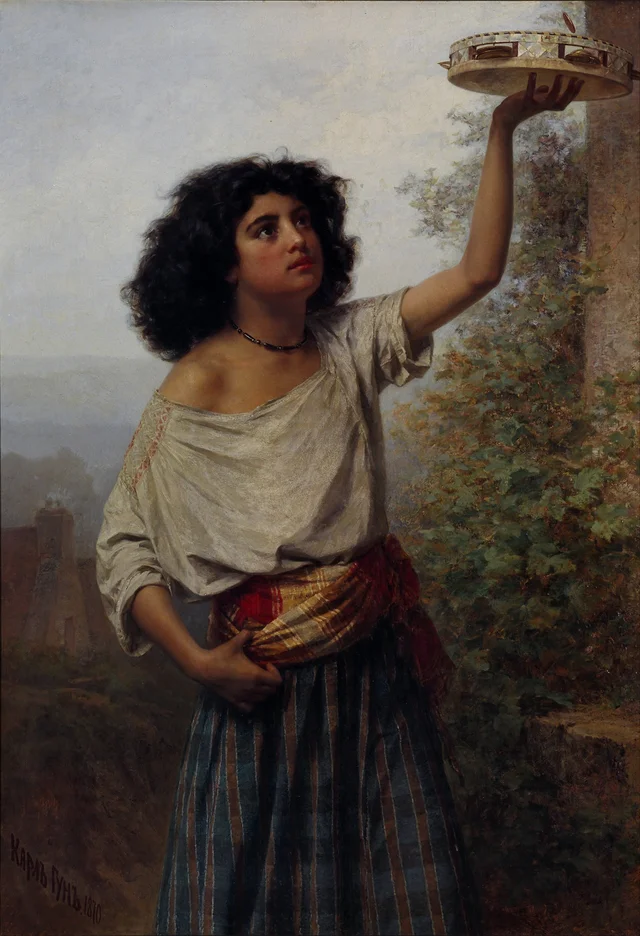
In the late 1860s Carl Huns was living in Paris on a fellowship from the Imperial Academy of Arts, showing at the Salon and painting scenes of ordinary life alongside history. Young Gypsy Woman, dated 1870, belongs to those years and is now in the Latvian National Museum of Art in Riga. In the same year he painted a scene from the Saint Bartholomew's Day Massacre, the killing of Protestants in Paris in 1572.
Huns was the son of a parish schoolteacher and organist in Livonia, in today's Latvia, and trained at the Academy in Saint Petersburg, where a gold medal in 1861 paid for his years abroad. Back in Saint Petersburg he became an academician in 1872, then a professor, and married Vera Monighetti, daughter of the architect Ippolit Monighetti. Soon afterwards he fell ill with tuberculosis. He went to Davos in Switzerland for treatment and died there in January 1877, aged 45.