Carlos de Haes
1826–1898 · Spain, Belgium · Realism, Landscape painting
The story
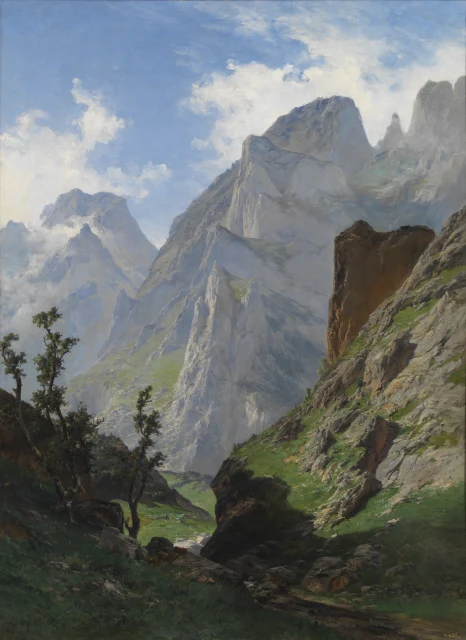
In 1874 Carlos de Haes settled himself in a gorge in the Picos de Europa, the limestone range above Spain's northern coast, and dated his study there on the spot. The picture he built from it, The Mancorbo Pass in Picos de Europa, is bare rock, loose scree and a cold sky, a mountain handled as geology. He sent it to the Exposición Nacional, the Spanish state art show, in 1876. It won nothing. The State bought it from him off the wall, and it is the work he is still known by.
He had been making that argument since the 1850s. Born in Brussels in 1826 and brought to Málaga as a boy of nine, he trained back in Belgium under the landscape painter Joseph Quinaux, and in 1857 he won the competition for the chair of landscape at the Academia de San Fernando, the royal art academy in Madrid. He held it for 30 years. Spanish landscape teaching then ran on ideal scenery composed indoors. Haes took his students out to the site and had them paint what stood in front of them, using the new railways to reach country that had rarely been painted.
Aureliano de Beruete and Darío de Regoyos both came out of those classes and carried open-air painting further into Spanish art. When Haes died in 1898 he left his pupils more than 4,000 small studies painted outdoors, kept all his life as private exercises, and most of them are now in the Prado.