Caspar Wolf
1735–1783 · Switzerland · Romanticism
The story
In the 1770s most Europeans still saw the high Alps as a wall of danger to be crossed quickly with your eyes shut. Caspar Wolf did the opposite. Born in 1735 in the Aargau village of Muri, the son of a cabinetmaker, he trained his eye first in Constance and then in Paris, in the studio of the landscape painter Philippe Jacques de Loutherbourg, who taught him to sketch outdoors in front of the thing itself.
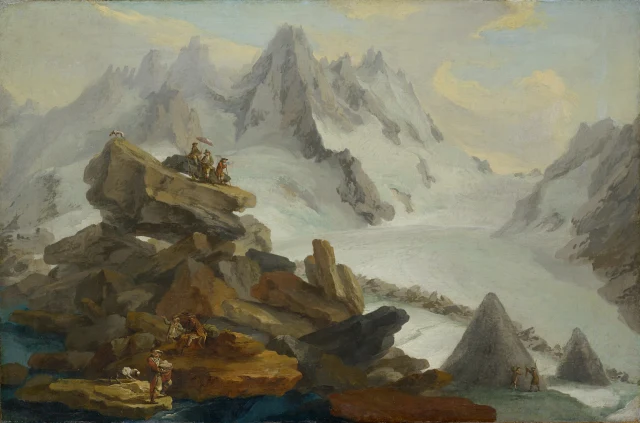
Back in Switzerland he found a patron with a strange ambition: the Bern publisher Abraham Wagner wanted an illustrated encyclopaedia of the Swiss mountains, drawn from nature at the highest standard. From 1773 Wolf spent his summers climbing into the glaciers and gorges of the Bernese Oberland, making pencil drawings and small oil studies on the spot, then working them up into finished canvases in the studio. He produced close to 200 of them.
What he painted was new. He put real people at the foot of real ice, tiny figures under overhanging rock and frozen waterfalls, the scale honest rather than flattering. He died in Heidelberg in 1783, largely forgotten, and it took another century for viewers to see that he had painted the Alps as they actually looked, years before the Romantics made mountains fashionable. Today his home region keeps a small museum devoted to him in Muri, where he was born.