Charles de La Fosse
1636–1716 · Kingdom of France · Baroque
The story
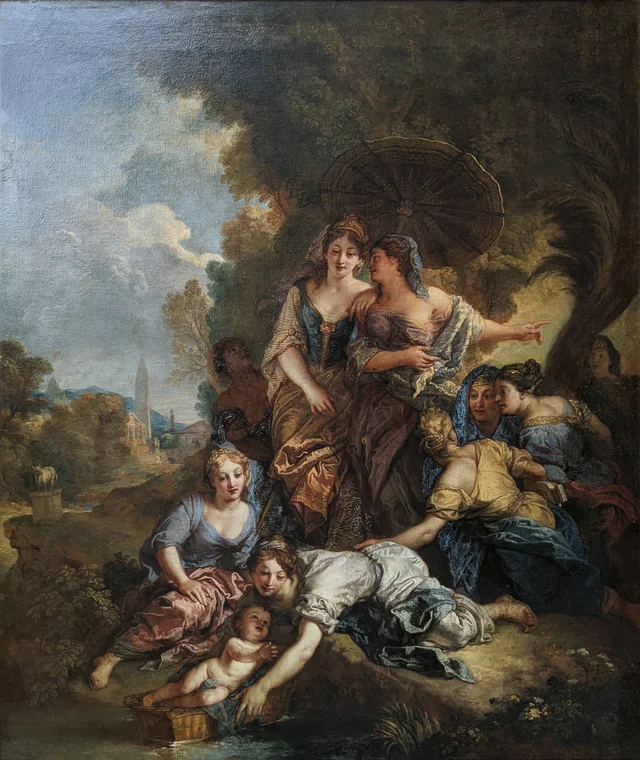
When Charles de La Fosse was learning to paint in Paris in the 1650s, French art had an official rulebook, and its author was his own teacher. Charles Le Brun, first painter to Louis XIV, held that drawing and clear design came first and that colour was mere decoration. La Fosse spent years in Italy on the king's money, studying Titian and Veronese, and came home convinced of the opposite: that colour could carry a picture. He became the quiet leader of the painters who admired Rubens, the Flemish master of warm, glowing flesh, and helped win the long Academy quarrel that opened the way to the lighter Rococo taste.
His largest surviving statement is overhead. In 1705 he painted the inside of the great cupola of Les Invalides, the veterans' church in Paris, with Saint Louis offering his sword to Christ among a swirl of figures seen from far below. At Versailles he left a Sunrise in the Salon d'Apollon and a Sacrifice of Iphigenia in the Salon de Diane.
For a stretch in the 1690s he worked in London, decorating Montagu House for the English aristocracy. He ended his life lodged with the collector Pierre Crozat, surrounded by one of the finest cabinets of pictures in Europe, and died there in 1716.