Charles Meynier
1763–1832 · France · Neoclassicism, History painting
The story
Early in 1793 riots against the French drove the young residents of the French Academy out of Rome. One of them, Charles Meynier, a Parisian who had won the Prix de Rome, the state's great prize for young painters, in 1789, spent the months that followed in Florence drawing Ghiberti's bronze doors on the Baptistery. By the end of the year he was back in Paris, a city now run by the Revolution.
He was a tailor's son, and an elder brother, an actor at the Comédie-Française, paid for his training with the painter François-André Vincent. Under Napoleon he became one of the state's main painters. In 1807 he entered the competition that Vivant Denon, director of the Musée Napoléon, set for a picture of the emperor on the battlefield of Eylau. Antoine-Jean Gros won it, and Meynier's sketch was among those the jury singled out behind the winner. He went on to paint Napoleon entering Berlin, and in 1812 the emperor returning to the island of Lobau after the Battle of Essling. Both canvases are now at Versailles.
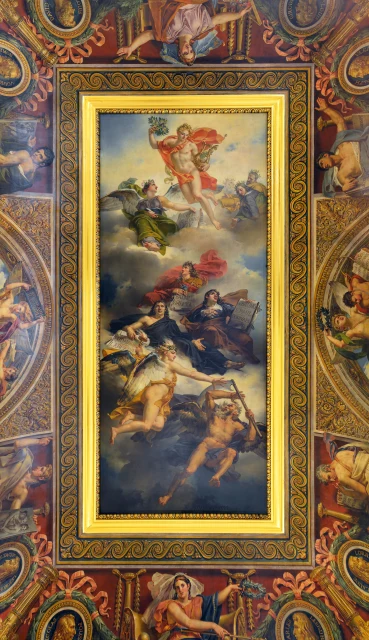
When the Bourbon kings came back he turned to decoration, and several of his painted ceilings are still overhead in the Louvre. Sources give his birth year as 1763 or 1768, and the catalogue of his work published in 2008 settles on 1763. He died in Paris in 1832 of cholera, as his wife also did.