Conrad von Soest
Holy Roman Empire · International Gothic
The story
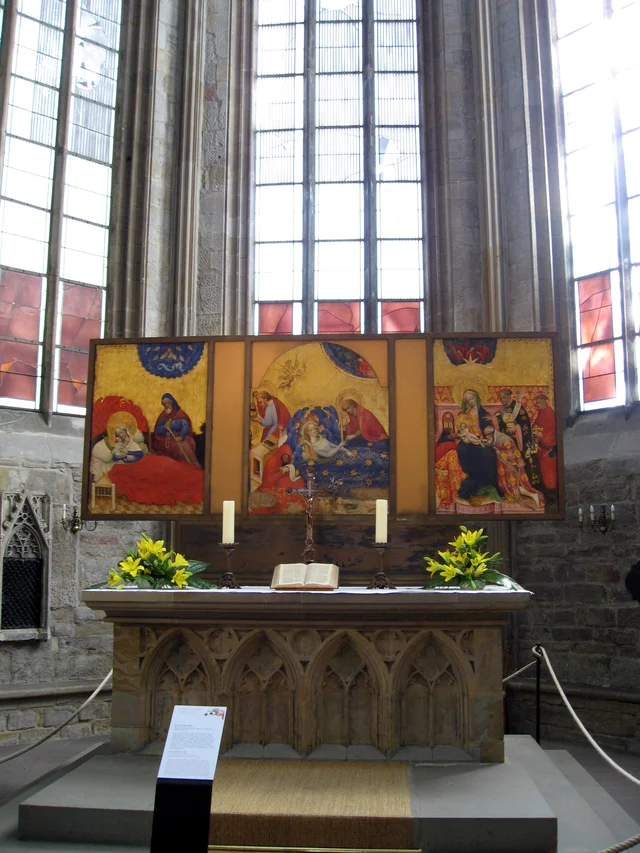
In the town church of Bad Wildungen, a small spa town in Hesse, one of the apostles on Conrad von Soest's great altarpiece is reading through a pair of spectacles. An inscription names the maker as Conrad, painter of Soest, and the work was finished around 1403. That apostle is often cited as the oldest picture of eyeglasses north of the Alps.
Conrad lived and worked in Dortmund, then a wealthy member of the Hanseatic League, the trading network of north German towns. His name refers to Soest, a nearby Westphalian town, though he was born in Dortmund around 1370. A record shows him marrying Gertrud von Münster there in 1394, and the documents follow him into the 1420s. His painting belongs to International Gothic, the refined courtly style shared across Europe around 1400, full of elegant figures, fashionable dress and gold.
His other great altarpiece stayed in his own city. Around 1420 he painted the Marienaltar for Dortmund's Marienkirche, the church of St Mary, with the death of the Virgin at its centre. In the early 18th century its panels were cut down to fit a new Baroque altar, and the trimmed panels are still in the church. Painters as far away as Lübeck, the Baltic port, and in Sweden took up his manner.