Constance Mayer
1775–1821 · France · Neoclassicism
The story
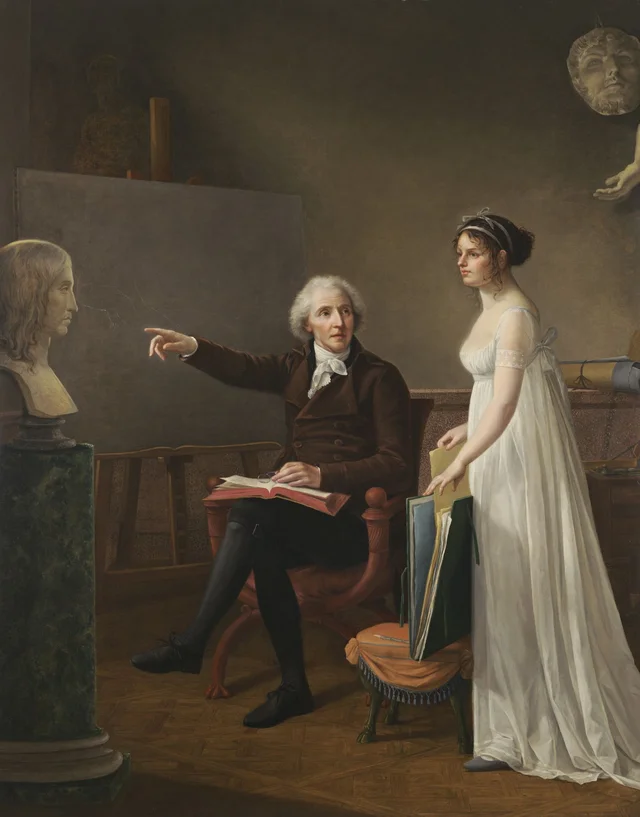
In 1803 a young French painter named Constance Mayer became a pupil of Pierre-Paul Prud'hon, a leading artist of the Napoleonic years known for his soft, dreamlike allegories. What grew between them was rare: the two worked so closely that Prud'hon would sketch a composition and Mayer would carry it to a finished painting in her own hand, so that telling their work apart is still difficult.
They lived side by side for years in an artists' quarter near the Sorbonne in Paris. Prud'hon was married, and though the arrangement was a true partnership of talent, it left Mayer's own name in his shadow. Several works long admired as his are now thought to be largely hers.
When Prud'hon's wife died in 1820 he was finally free to remarry, and he refused. Mayer, in her mid-forties and increasingly desperate, cut her own throat in the studio they shared in May 1821. Prud'hon was shattered. He finished the canvas she had left on the easel, showed it at the Salon the next year in her memory, and died himself less than two years afterward.