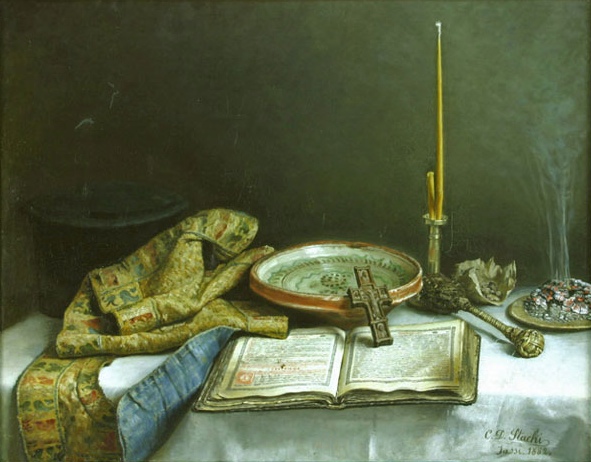
Constantin Daniel Stahi
1844–1920 · Principality of Moldavia, Romania · Realism, Academic art
The story
Stahi went to Munich in his twenties and stayed for years, learning painting alongside engraving on copper and on wood. Engraving is slow work done very close to the surface, at the scale of a page, and it left its mark on everything he did afterwards.
Back home he taught at the fine arts school in Iasi, where he had trained under Gheorghe Panaiteanu-Bardasare, the painter who founded it, and he ran the school himself from 1892 to 1902. His own pictures kept shrinking towards the tabletop. Old books with broken bindings, worn shoes, chairs, plates of grapes, quinces and walnuts, a porcelain vessel, and objects out of the church, among them a holy-water stoup he painted in 1882 that is now in Bucharest.
This was Romania's loudest patriotic decade, the kingdom newly independent and hungry for battle scenes and portraits of its statesmen, and none of that reached his easel. He was born in 1844 at Dobreni in Neamt county, and several of his still lifes now hang in the art museum at Piatra Neamt, half an hour from the village.