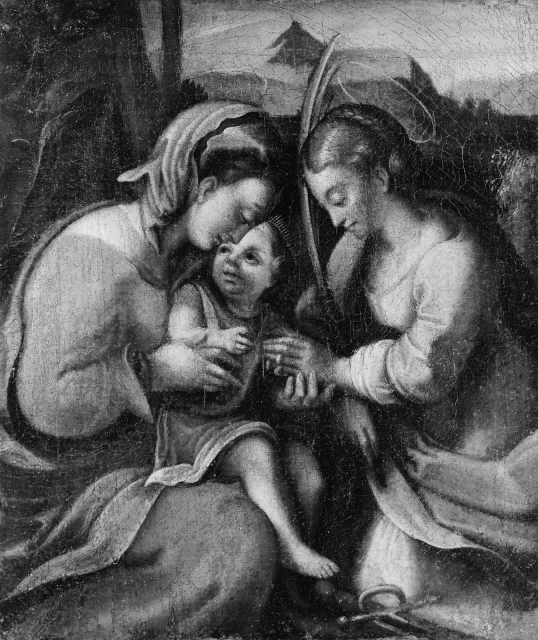
Copy after Antonio da Correggio
The story
Copy after is the label a museum gives to a painting whose design belongs to a known master while the brushwork belongs to somebody else. Under this heading the master is Correggio, the Renaissance painter of Parma. The copyist is usually unnamed and the date unknown, and the label makes no claim that Correggio ever touched the canvas. Painters travelling in Italy in the 1700s copied his altarpieces as part of their training, and collectors who could not hope for an original bought careful repetitions of his small devotional pictures.
In Parma itself copying him became a school exercise. In the 19th century the city's Academy of Fine Arts used some of his paintings as models for its students, mounting them on frames that could be turned toward the light. The engraver Paolo Toschi, who directed the academy, spent five years, from 1839 to 1843, copying Correggio's frescoes in watercolour so that they could be engraved.