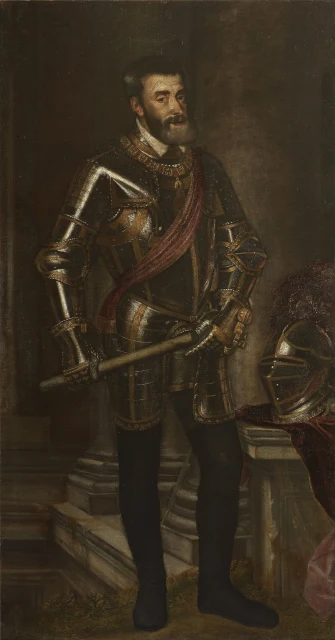
Copy after Titian
The story
In the storerooms of the Galleria Palatina at Palazzo Pitti stands a canvas almost two metres high showing Emperor Charles V in armour. The Titian it repeats no longer exists. Two state records describe the picture and disagree about whether the copyist was Venetian or Florentine, and neither can give him a name. This heading covers exactly that situation, a composition by Titian carried by another man's brush.
Copying was a training and a trade at once. Apprentices learned the craft by repeating their master's pictures, and grown painters earned a living at it, because a duke or a convent that wanted a famous composition and could not have the original commissioned a version instead. Even Rubens did it. During the eight months the Antwerp painter spent at the Spanish court in 1628 and 1629 he made full-size copies of the Titians hanging in the royal collection.
Copies also carry information forward. Titian's double portrait of Charles V with the Empress Isabella is known today only through the one Rubens made of it, the original having burned in a palace fire. The Pitti canvas had a rougher afterlife. Its composition originally stopped at the knees and the copyist extended it downwards, and the canvas was then cut down in 1677 and again in 1687 so that it would match the portrait of Philip II it hung beside.