Cornelis Vroom
1661 · Dutch Republic · Dutch Golden Age
The story
Around 1628 an English court record lists Cornelis Vroom, a landscape painter from Haarlem, among the painters of King Charles I of England, and a payment of 80 pounds, a very large sum for a painter, went to him or possibly to his younger brother Frederick. By July 1629 he was back in Haarlem signing documents, and that Dutch city was where he stayed.
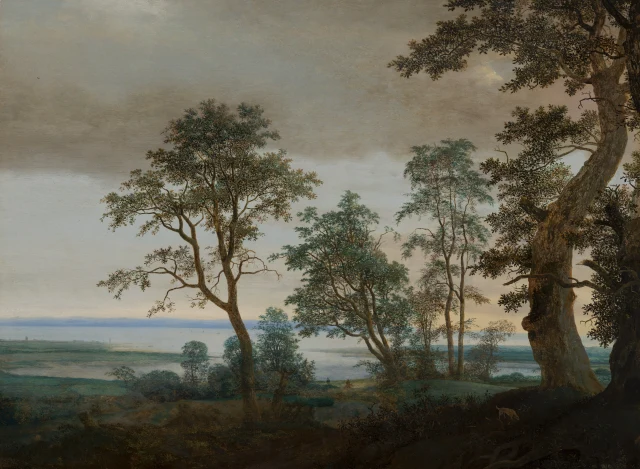
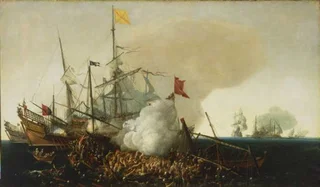
He grew up in a workshop full of ships. His father, Hendrick Vroom, is regarded as the founder of Dutch marine painting, and Cornelis began with ships and harbours too. Then he turned inland. In a small panel dated 1626, now in the National Gallery in London, the wood itself is the subject. The trees stand in front of the view, dark against the light, and the sunlit fields beyond show only through gaps in the leaves.
That way of seeing a landscape through a screen of trees was taken up by the next generation in Haarlem, above all by the young Jacob van Ruisdael, later famous for his Dutch woods and skies. Vroom also sold work to the court of the stadholder, the Dutch head of state, in The Hague. He joined the Haarlem painters' guild in 1634 and was buried in the city in September 1661.