Daswanth
1584 · Mughal Empire · Mughal painting, Islamic art
The story
At the court of Akbar, the Mughal emperor of northern India, a painting was often the work of two people. One artist drew the composition, another laid in the colour, and a court scribe wrote both names in the margin. Daswanth's name turns up again and again as the one who drew.
He came from the bottom of that world. His father was a palanquin-bearer, one of the men who carried the nobles' litters, and the boy was noticed for figures he drew on walls. Akbar placed him under Abd al-Samad, a Persian master who had come to India with the emperor's father. Abu'l-Fazl, Akbar's court historian, later ranked Daswanth first among the painters of the age.
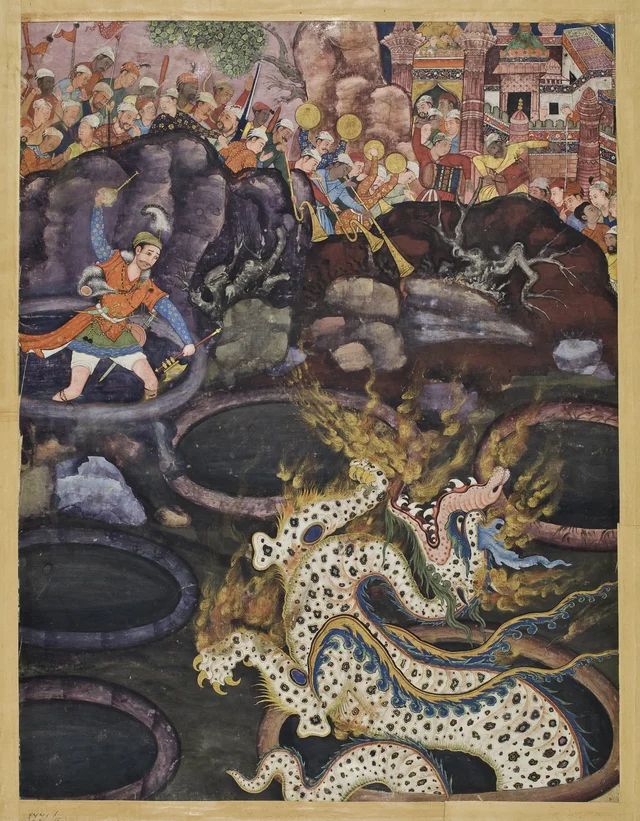
He worked on the Hamzanama, the huge illustrated romance of the hero Amir Hamza painted on cloth for Akbar, and three pages of the Tutinama, a book of tales told by a parrot, now in Cleveland are attributed to him. His largest surviving share is in the Razmnama, the Persian version of the Indian epic the Mahabharata, begun in 1582, where he designed around 30 scenes that other painters then coloured.
Abu'l-Fazl also recorded the end. Daswanth's mind gave way, and in 1584 he wounded himself with a dagger and died of it. The chronicles give no year for his birth.