Dionysios Tsokos
1820–1862 · United States of the Ionian Islands, Greece · Heptanese school, Romanticism
The story
In his last years the Greek state asked Dionysios Tsokos to paint the men who had fought the war of independence of 1821, while enough of them were still alive to sit for a portrait. He worked through part of the list and died in 1862 with the series unfinished. The finished heads went to the National Historical Museum in Athens, and the studies for them are divided today between the Benaki Museum and the Koutlidis collection.
He had come to Athens in 1847 from outside the kingdom. Zakynthos, where he was born, belonged to the Ionian Islands under British protection, and painting there had kept an unbroken Italian tradition. He is said to have taken his first lessons from Nikolaos Kantounis, a priest and painter on the island, and by 1844 he was at the academy in Venice with Ludovico Lipparini, a history painter who told him to concentrate on portraits and on the past. He exhibited in Venice in 1845 and 1846.
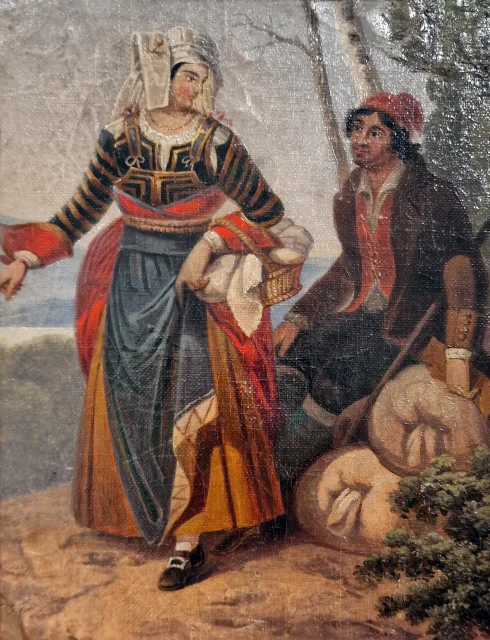
The kingdom he moved to was 15 years old and short of pictures of itself, and Tsokos supplied them: the death of Markos Botsaris, the Souliot commander killed in 1823, and portrait after portrait, including the professors of the new University of Athens for its ceremonial hall. In 1856 he was made professor of drawing and painting at the Arsakeio, the Athens girls' school that trained teachers. He went on painting Ionian subjects alongside the heroes, among them a Corfiot woman with a young man, now in the National Gallery in Athens.