Dirck Jacobsz
1496–1567 · Habsburg Netherlands · Dutch Renaissance, Northern Renaissance
The story
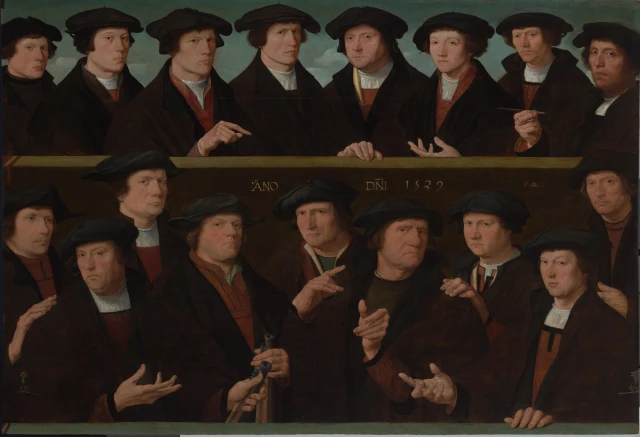
In 1529 the arquebusiers of Amsterdam, the company of the civic guard armed with early firearms, had Dirck Jacobsz paint them for their headquarters, the Kloveniersdoelen. Seventeen men stand in two rows behind a balustrade, stiff and frontal, and each is given something to hold: a gun, a glass, a silver dish, a sheet of music, even a herring with a knife. It is the earliest known Dutch civic guard portrait, the start of a tradition that led to Rembrandt's Night Watch, painted for the same building more than a century later.
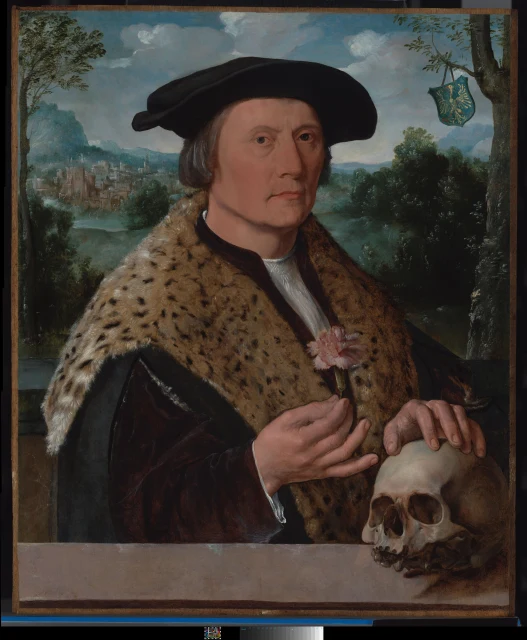
Dirck was the son of Jacob Cornelisz van Oostsanen, one of the leading painters in Amsterdam, and trained in his father's workshop. The Italian-influenced manner of Jan van Scorel, a Dutch painter back from Rome, left a clear mark on him. Portraits were his strength. Around 1531 he painted Pompejus Occo, the agent of the Fugger bank in Amsterdam and one of the richest men in the city, with one hand resting on a skull and a red carnation in the other, a reminder that wealth does not last.
In the 1529 panel, the man at the upper right holds a paintbrush instead of a weapon, and he is probably Dirck himself. Two wings with seven more guardsmen each were added later, and the whole triptych is now in the Rijksmuseum, on loan from the city of Amsterdam since 1885.