Dirk Valkenburg
1675–1721 · Dutch Republic · Baroque
The story
In 1706 Jonas Witsen, the wealthy city secretary of Amsterdam, sent a painter to his sugar plantations in Suriname, the Dutch colony on the northern coast of South America. Dirk Valkenburg went out on a contract as bookkeeper, clerk and painter, with orders to record the estates as they looked and to draw the colony's rare birds and plants. Witsen had inherited three plantations, Waterland, Surimombo and Palmeneribo, and he owned the enslaved people who worked them.
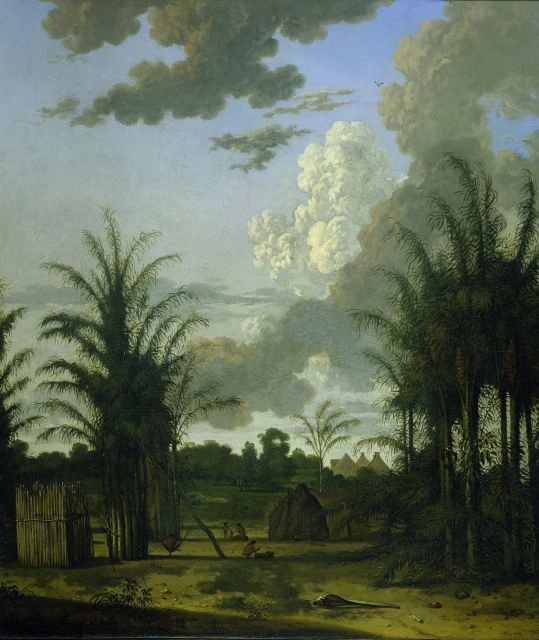
The small canvas in the Rijksmuseum, dated 1707, shows one of the sugar plantations along the Suriname River, possibly Palmeneribo. In the foreground are Lokono, Indigenous people of the region, with a palm-thatched hut and someone resting in a hammock. As the museum points out, the many enslaved people who did the work on the plantation are left out of the picture. Valkenburg did paint them elsewhere. A canvas in the National Gallery of Denmark in Copenhagen shows a gathering of enslaved people on one of Witsen's plantations.
Before Suriname, Valkenburg had trained in Amsterdam with Jan Weenix, a painter of hunting still lifes, worked in Vienna for the Prince of Liechtenstein in 1698 and painted for the king-stadholder William III at his palace of Het Loo. Ill health cut the Suriname stay short, and he sailed home, probably with the autumn convoy of 1707. He spent his last years in Amsterdam, painting mostly portraits, and died there in 1721.