Domenico Aspari
1746–1831 · Duchy of Milan, Kingdom of Lombardy–Venetia · Neoclassicism
The story
Between 1786 and 1792 Domenico Aspari cut 16 large copper plates of Milan. The courtyard of the Brera palace, the columns of San Lorenzo, the Castello, the new Teatro alla Scala, the Duomo, each sheet more than 60 centimetres along its long side, worked with the burin and the drypoint needle in a manner he had taken from Piranesi's Roman views. The Napoleonic years that followed changed a good deal of what he had drawn.
He had trained as a painter, at the academy in Parma, and then more or less stopped. Early accounts put it down to poverty, a shortage of commissions, and what one of them calls an invincible shyness. In 1776 he took a post teaching figure drawing at the newly founded Brera academy in Milan and held it for 50 years.
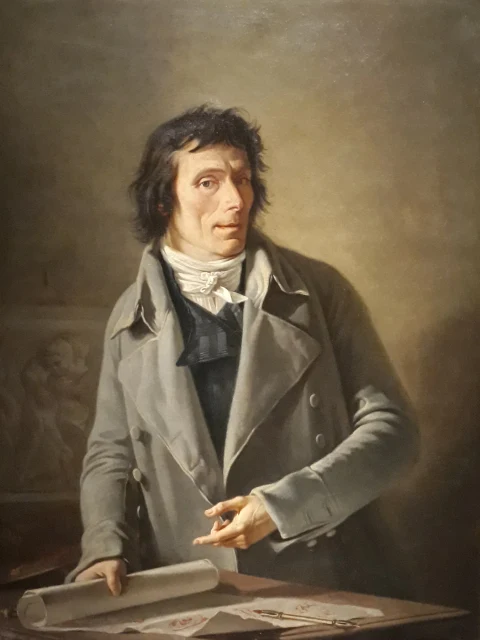
His self-portrait hangs in the Pinacoteca di Brera and dates from 1805, the year Napoleon was crowned king of Italy in the cathedral a few streets away. Giuseppe Bossi, the academy's secretary, was then assembling a gallery of painters' portraits, and Aspari, who taught in the building, painted himself into it. That collection of faces was among the first things the Pinacoteca showed when it opened to the public in 1809.