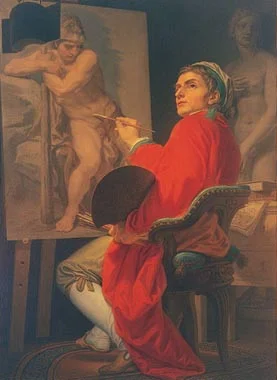
Domenico Corvi
1721–1803 · Papal States · Neoclassicism, Rococo
The story
Rome in the 1750s was caught between two tastes. The warm, worldly late-Rococo of Pompeo Batoni still filled the great commissions, while a colder, more severe manner was arriving with the German painter Anton Raphael Mengs, the beginning of what we now call Neoclassicism. Domenico Corvi, born in Viterbo north of Rome in 1721, worked right in that seam and made a style that sits between the two.
He came up the ordinary way, training under the Roman painter Francesco Mancini, winning first prize at the Accademia di San Luca in 1750 and full membership six years later. His best decade ran from the mid-1760s, when the Borghese, one of Rome's great families, put him on a fixed salary for ten years.
His deeper influence was on the men he taught. Three of the leading Neoclassical painters of the next generation — Giuseppe Cades, Gaspare Landi, and Vincenzo Camuccini — learned their craft in his studio, so the severe new manner Rome adopted after him passed partly through his hands.