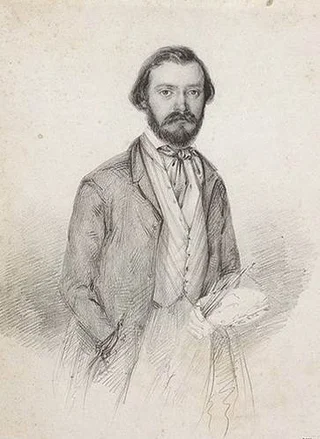
Domenico Induno
1815–1878 · Kingdom of Lombardy–Venetia, Kingdom of Italy · Romanticism, Realism
The story
For five days in March 1848 Milan fought the Austrian garrison from behind barricades of paving stones and furniture, and two of the men in the streets were brothers who painted for a living, Domenico and Gerolamo Induno. The rising took the city, then the war that followed was lost. By August, Domenico had crossed into Canton Ticino, over the Swiss border, with his wife and his brother. He went on to Florence and did not settle in Milan again until the end of 1849.
He had reached painting sideways. His father cooked at the Milanese court, and Domenico was put to a goldsmith, Luigi Cossa, who noticed him drawing and pushed him towards the Brera academy. He enrolled in 1831, at 16, and studied under Francesco Hayez, the most celebrated history painter in Italy at the time.
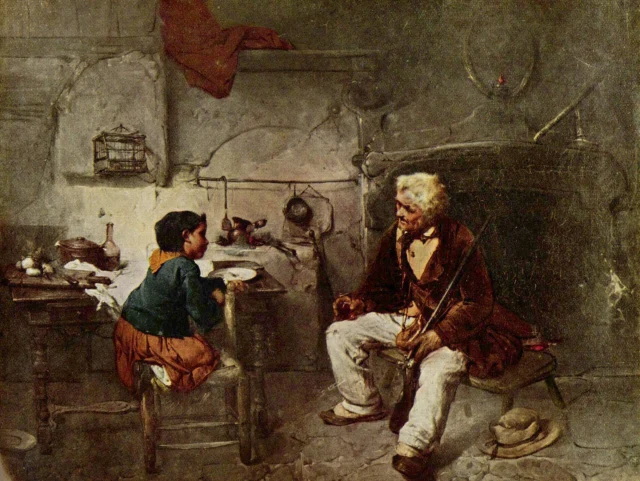
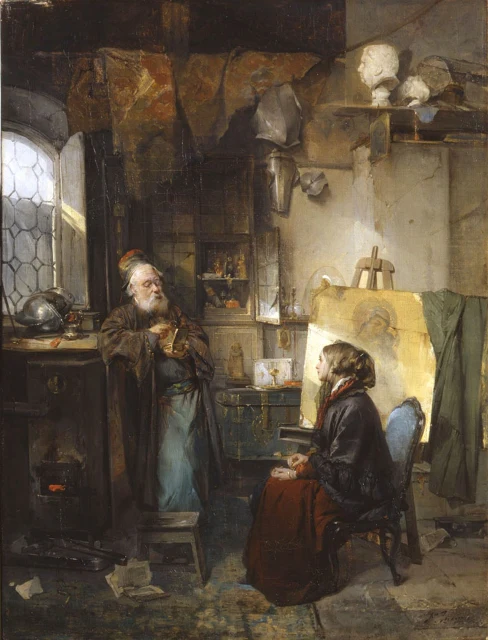
What he made his name on was domestic and small. A woman begging at a door, a conscript leaving home, a family driven out of a burned village, a hunter sitting with his gun butt-down between his knees. Liberal Milanese collectors bought these, and the politics were carried in the detail. His best-known canvas, from 1862, shows a room of people reading the bulletin of 14 July 1859, which brought Milan the terms of the armistice of Villafranca and the news that Venice would stay Austrian. The subject is the moment that news landed on ordinary faces. Vittorio Emanuele II, the new king, made him a knight of Saints Maurice and Lazarus for that picture. From 1863, the year the Brera made him a counsellor of the academy, he stopped sending work to its exhibitions.