Edouard Louis Dubufe
1819–1883 · France · Academic art, Romanticism
The story
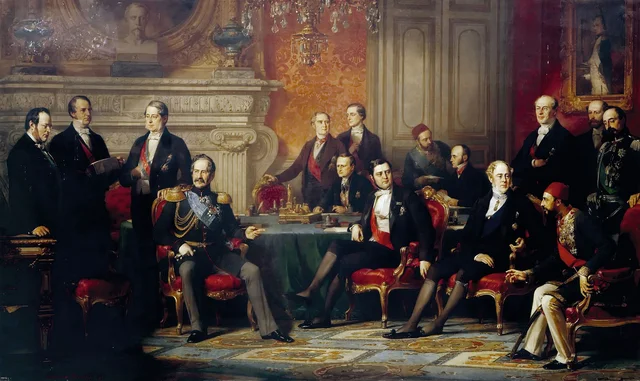
When the Crimean War ended in 1856, the peace was negotiated in Paris, and Napoleon III wanted the moment on canvas. The commission went to Édouard Dubufe, the fashionable portraitist of the new imperial court. His Congress of Paris, more than five metres wide, gathers the delegates of the great powers in one room, Count Cavour, the statesman of Piedmont, among them, while the emperor himself is present only as a bust.
Dubufe was born in Paris in 1819 into a family of painters. His father Claude-Marie taught him first, then he studied with Paul Delaroche, a celebrated history painter, and his own son Guillaume became a painter as well. His marriage tied him to music too. His wife Juliette was the daughter of the pianist Pierre-Joseph Zimmerman, and her sister married the composer Charles Gounod.
The polished society portrait was his real trade. From 1853 he painted Napoleon III and the empress Eugénie, then aristocrats, wealthy Parisians and stars such as the actress Rachel. In 1857 he portrayed Rosa Bonheur, the famous animal painter, beside a bull, and Bonheur painted the bull herself. In 1866 the young critic Émile Zola questioned his fitness to sit on the jury of the Salon, the official annual exhibition. Dubufe died in 1883 at Versailles, where his Congress of Paris now hangs.