Eero Järnefelt
1863–1937 · Finland, Grand Duchy of Finland · Romantic nationalism
The story
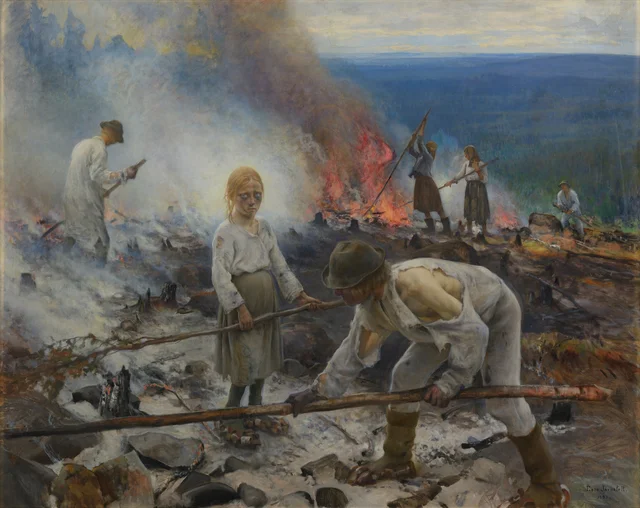
A barefoot girl stands in the smoke and looks straight out at you. She is the figure everyone remembers from Under the Yoke, the painting Eero Järnefelt made in 1893, and behind her men and women are burning brushwood to clear a patch of forest for planting. This was slash-and-burn farming, back-breaking work done by the poorest people in eastern Finland, and Järnefelt had gone out to sketch and photograph them before he painted. He gave the tired child in the foreground a level, unhappy gaze that turned a scene of rural labour into something closer to an accusation.
Järnefelt trained in Saint Petersburg and Paris, but his subject was Finland: its people, and the forests and lake views around Koli, a ridge in the east he returned to for the rest of his life. He belonged to a remarkable family. His mother kept a famous literary salon, his brother Arvid became a writer in the circle of Tolstoy, and his sister Aino married the composer Jean Sibelius.
He won medals in Paris, taught a generation of Finnish painters, and led the country's academy of art. All of this came while Finland was still a grand duchy under the Russian tsar, in the decades when its writers, composers and painters were building a national culture. When he died in 1937, that country had been independent for 20 years.