Émile Friant
1863–1932 · France · École de Nancy
The story
Émile Friant made his name with a scene of mourning. His large canvas La Toussaint, shown at the Salon in 1889, follows a family in deep black crossing a cemetery gate on All Saints' Day, their arms full of chrysanthemums, a beggar reaching out to them at the edge. Friant handled the great expanses of black and white with such control, and painted the faces so exactly, that the picture was an immediate sensation. The French state bought it, and it hangs today in the museum of his home city, Nancy.
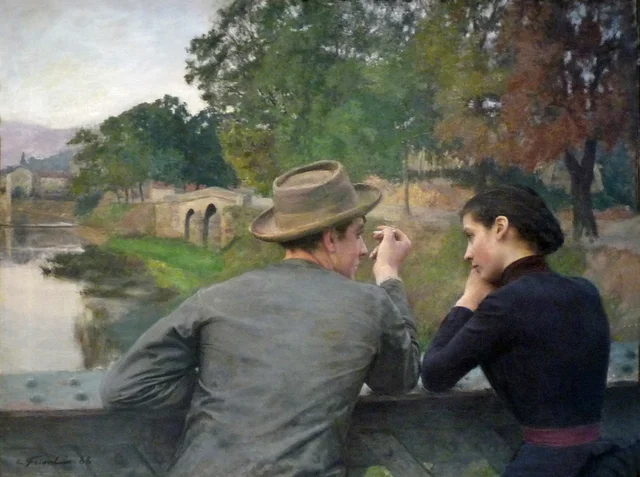
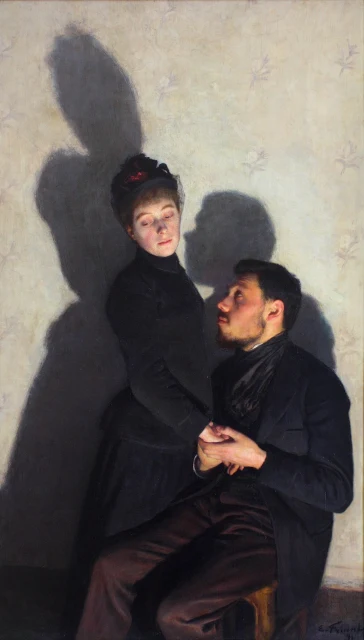
Friant belonged to Nancy in eastern France, the town that would soon become the centre of the Art Nouveau movement known as the École de Nancy. He trained partly there and partly in Paris, and he held to a sober, almost photographic Naturalism, painting ordinary people, boaters, lovers, workers, with a precision that later earned him the label of the last of the naturalists.
That precision was partly the point and partly his limit. As Impressionism and then the avant-garde pulled French painting toward looser brushwork and pure colour, Friant's exact realism came to look old-fashioned, and his fame faded outside Nancy. He kept working and teaching, was elected to the Institut de France in 1923, and died in Paris in 1932.