Enguerrand Quarton
France · School of Avignon
The story
In the spring of 1453 a canon of Avignon, Jean de Montagnac, signed a contract with a painter for an altarpiece in the Carthusian monastery across the Rhône at Villeneuve-lès-Avignon. The painter was Enguerrand Quarton, born around 1410 in the diocese of Laon in northern France, who had settled in Provence in 1444 and worked in Aix and Arles before making Avignon his base. The contract survives, and it reads like a shopping list for heaven and earth.
It asks for Rome on one side and Jerusalem on the other, for purgatory and hell below, and for God the Father and God the Son to look exactly alike. On the Virgin herself it leaves the painter to do as he thinks best. Quarton was given 17 months, and the finished Coronation of the Virgin is still in Villeneuve, in the town's Musée Pierre-de-Luxembourg.
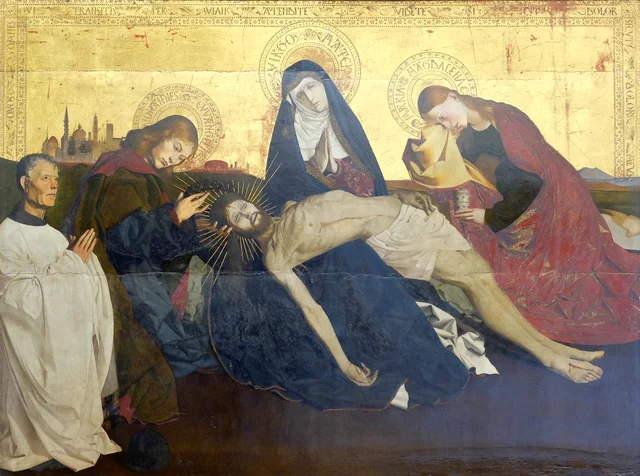
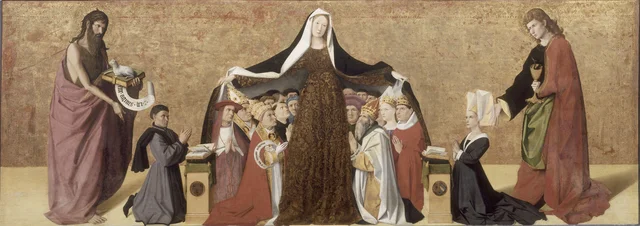
His most famous picture has no paperwork at all. The Pietà of Villeneuve-lès-Avignon, with the dead Christ laid across his mother's knees against a gold sky, was shown in Paris in 1904 at an exhibition of early French painting, and the Friends of the Louvre, a society of donors, bought it the next year. Its author was argued over for decades, and only from around the 1960s did most scholars accept Quarton, as the Louvre does today. An earlier altarpiece, the Virgin of Mercy he painted in 1452 with a fellow painter, Pierre Villate, for the Cadard family, hangs in the Musée Condé in the château of Chantilly, north of Paris.