Ernest Quost
1842–1931 · France
The story
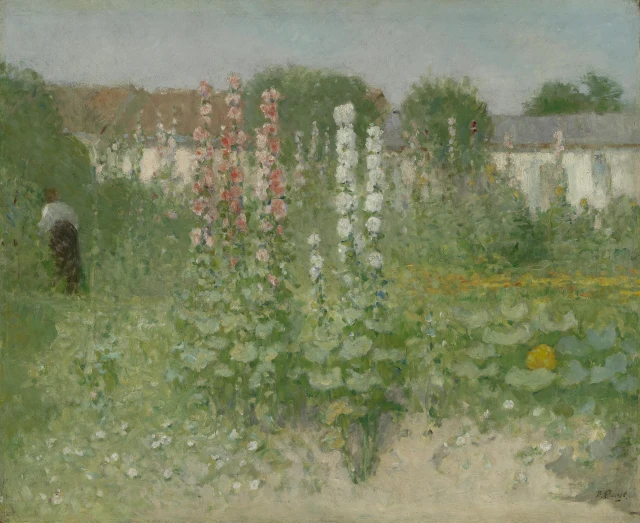
In January 1889, writing to his brother Theo from Arles, Van Gogh divided the flowers among painters. Georges Jeannin, a Paris still-life specialist, had the peony. Ernest Quost had the hollyhock. The sunflower, Van Gogh said, was his own, in a way.
Quost came by that hollyhock honestly. He learned floral decoration at the Sèvres porcelain works outside Paris, studied plants with a gardener in Saint-Ouen on the city's northern edge, and through the 1870s and 1880s kept his own garden in Montmartre, where he painted the tall pink and white spires he had grown himself. He made his Salon debut in 1866 and stayed with the official exhibitions for decades, taking a silver medal at the 1889 Exposition Universelle in Paris and the Légion d'honneur. Monet liked his flowers too.
One of those hollyhock gardens carries an inscription on the back: “To Theo van Gogh. This painting that my friend Vincent loves so much. With warm regards, E. Quost.” The present tense reads like a gift meant while Vincent was still alive, and Vincent may have seen the canvas in Paris in early July 1890, weeks before his death. It never turned up in Theo's estate. The Van Gogh Museum bought it from a private collection in 1996.