Eugène Carrière
1849–1906 · France · Symbolism
The story
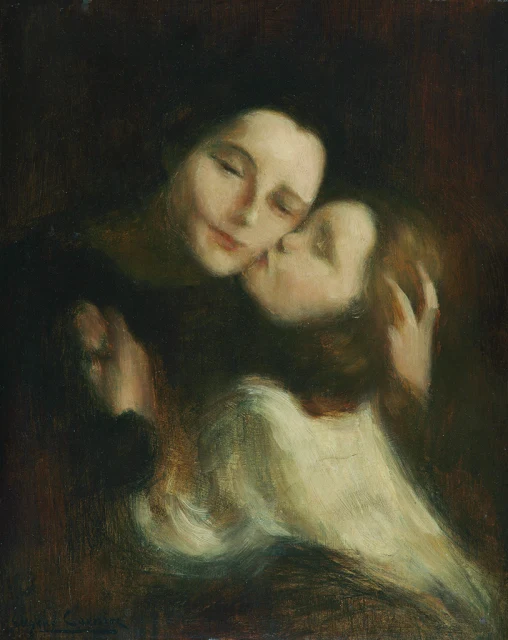
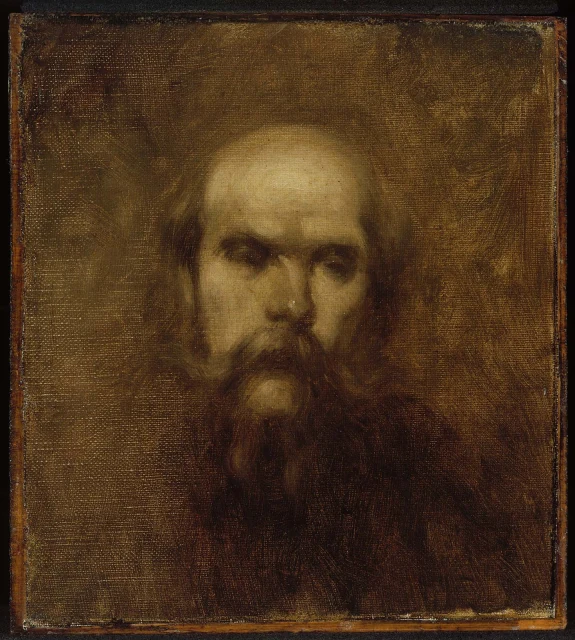
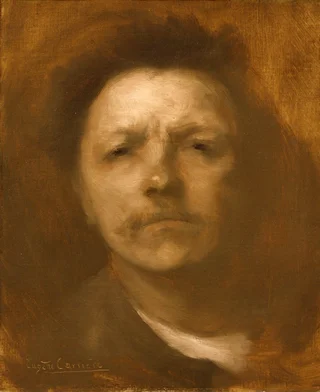
By about 1890 Eugène Carrière had settled on the thing that makes his canvases unmistakable, figures surfacing out of a brown and gray fog, softly lit, as if seen through breath on cold glass. Before that his colour had been warmer, closer to Rubens, the Flemish master whose paintings he studied while held prisoner in Dresden during the Franco-Prussian War of 1870.
Most of what he painted was his own household. His wife and children appear again and again, folded together in tender, half-dissolved domestic scenes. One of the earliest, The Young Mother of 1879, hangs today in the fine-arts museum at Rouen in Normandy. He had trained at the École des Beaux-Arts in Paris under Alexandre Cabanel, a pillar of the official Salon, before breaking with that world to help found the breakaway Société Nationale des Beaux-Arts.
Carrière was a close friend of the sculptor Auguste Rodin, and his fogged, monochrome manner left a lasting mark. Art historians see its echo in the young Picasso's Blue Period, those melancholy figures painted in almost a single colour. He also taught, running classes at the Académie de la Palette in Paris, and died of throat cancer in 1906, at 57.