Evaristo Baschenis
1617–1677 · Republic of Venice · Baroque
The story
A day's ride south of Bergamo, in Cremona, the Amati workshop was turning out the violins that made that town famous across Europe. Evaristo Baschenis spent his working life painting instruments of the same kind, laid out on a table in the corner of a room, and he did it while serving as a priest.
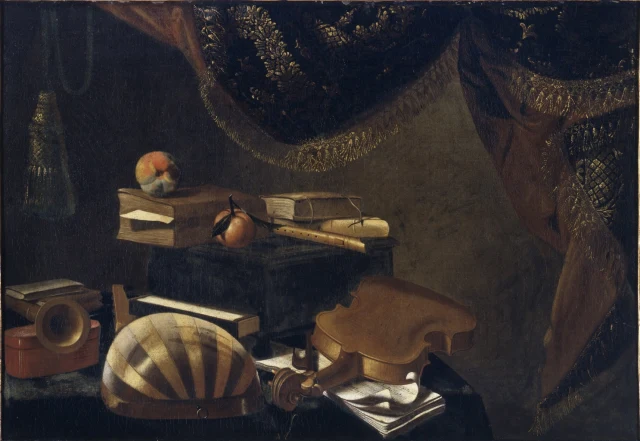
He was ordained in 1643 and was known around Bergamo as Prevaristo, prete Evaristo run together, Father Evaristo. He was the last painter of a family that had worked the mountain valleys north of the city for something like two centuries, frescoing village churches around the Valle Averara for whoever could pay. He did none of that. He painted lutes, a mandola, violins, a bombarda, sheets of tablature and bound music, sometimes fruit, sometimes a curtain drawn across behind them.
The detail everyone remarks on is the dust. On the back of a lute lying face down he painted the grey film that settles on an instrument nobody has picked up for a while, in places with a mark drawn through it by a finger. Dust in a still life is a standing reminder of time passing, and it is also something he had plainly looked at closely.
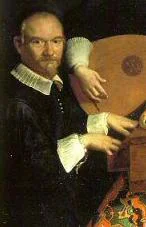
He appears in one of his own paintings. The Agliardi triptych, made around 1665 for one of the oldest noble families of Bergamo, shows him in priest's dress at the spinet, accompanying three Agliardi brothers on lutes and a guitar. He kept instruments and music in his own rooms, on what a parish income allowed.