Félix Castello
1595–1651 · Spain · Baroque
The story
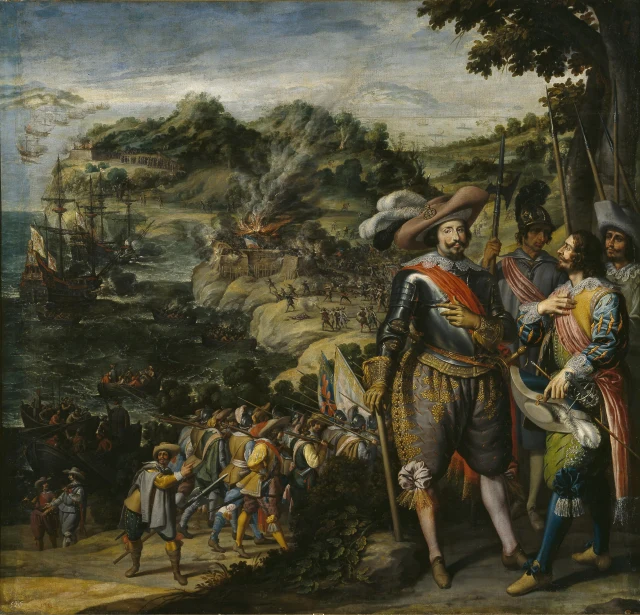
The victory Félix Castello was asked to paint had come undone before he started painting it. In 1629 a Spanish squadron under Fadrique de Toledo, on its way to America to escort the silver shipments home, put in at the small Caribbean island of San Cristóbal, drove off the English and French who had settled there and burned their tobacco. The settlers were back within a few years. Castello began the canvas with the island in foreign hands again and signed it in 1634, and it went up all the same in the Hall of Realms, the throne room of the new Buen Retiro palace in Madrid, one of 12 battle pieces that included Velázquez's Surrender of Breda. In the foreground he put Fadrique de Toledo with his baton of command, dressed and featured much as Juan Bautista Maíno had painted him for a canvas hanging in the same room.
Castello was born in Madrid to a Spanish mother, the third generation of his family in the service of the Spanish crown. His grandfather Giovanni Battista Castello, known as il Bergamasco, was brought over from Genoa by Philip II. His father Fabrizio painted at the Escorial and was his first teacher. He applied for the post of painter to the king twice, in 1617 and in 1627, and was refused both times. Most of the work he did get came through Vicente Carducho, the court painter he attached himself to after his father's death and stayed close to for the rest of Carducho's life. When Carducho died in 1638, Castello was one of the men appointed to value his paintings and drawings, and he used the job to buy colours and prints for his own workshop.