Felix Nussbaum
1904–1944 · German Reich · New Objectivity
The story
Sometime around 1943, hiding in a rented room in Brussels, Felix Nussbaum painted himself cornered against a grey wall, collar turned up to show a yellow star, holding out an identity card stamped Jew. He was in his late thirties, and he knew almost exactly what was coming.
Nussbaum had been born in 1904 into a comfortable Jewish family in Osnabrück, in northern Germany, and trained as a painter in Berlin, working in the sober, sharp-edged manner of the New Objectivity that flourished in Germany between the wars. He won a Rome fellowship in 1932. Within a year Hitler was in power, his Berlin studio and much of his early work had burned, and he never lived in Germany again.
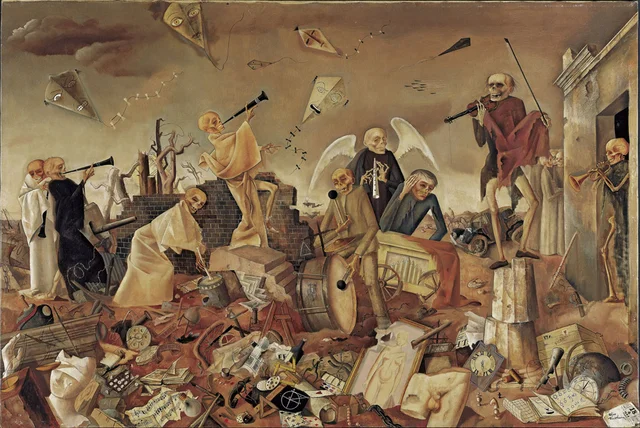
The rest was exile. He moved through Italy, then Belgium, was briefly interned by the French as an enemy alien, escaped, and went underground in Brussels with his wife, the painter Felka Platek. In hiding he kept painting, and the pictures grew heavier with dread, full of coffins, skeletons, dead trees and walled-in figures. In 1944 the couple were denounced, arrested, and deported on one of the last transports to Auschwitz, where both were murdered.
Much of the work was saved and eventually returned to his home town. In 1998 Osnabrück opened the Felix Nussbaum Haus, a jagged, deliberately disorienting building by the architect Daniel Libeskind, built to hold his paintings.