Ferdinand Hart Nibbrig
1866–1915 · Dutch · Luminism, Pointillism
The story
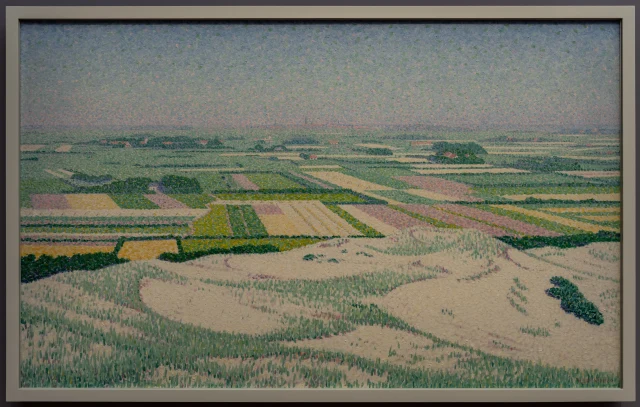
In Paris in the late 1880s, a young Amsterdam painter named Ferdinand Hart Nibbrig ran into the two influences that set his course, the work of Vincent van Gogh, a fellow Dutchman only recently dead, and the dotted canvases of Georges Seurat, the Frenchman who built pictures out of tiny points of pure colour. Nibbrig came home won over to that pointillist method, though he never applied it strictly, always loosening the dots back into freer, impressionist strokes.
What truly transformed his palette was closer to home. Around 1892 he discovered the bulb fields near Hillegom and Bennebroek, the broad blocks of tulips and hyacinths that turn the Dutch spring into flat bands of colour, and his painting grew brighter and full of light. In 1894 he settled in Laren, the artists' village east of Amsterdam, where he made luminous landscapes and small-town views.
He had studied at the Rijksakademie in Amsterdam and, briefly, at the Académie Julian in Paris. Today he is counted among the first painters to carry luminism, that high-keyed brightness, into Dutch art. He died in Laren in 1915, not yet 50.