Ferdynand Ruszczyc
1870–1936 · Second Polish Republic, Russian Empire · Symbolism
The story
Ferdynand Ruszczyc came to painting by a detour. Born in 1870 on a country estate at Bohdanów, in the old Polish-Lithuanian borderlands then ruled by the Russian Empire, he first went to St Petersburg to study law before giving it up for the Imperial Academy of Arts and its landscape classes.
In 1898, at 28, he painted the picture that made his name, called simply Earth. A peasant drives a team of oxen up a low rise against a huge, heavy sky of piled cloud, the ploughman and the land pressed together under it. It caught a feeling many in partitioned Poland recognised, the tie between a people and its soil, and it was hailed across Europe.
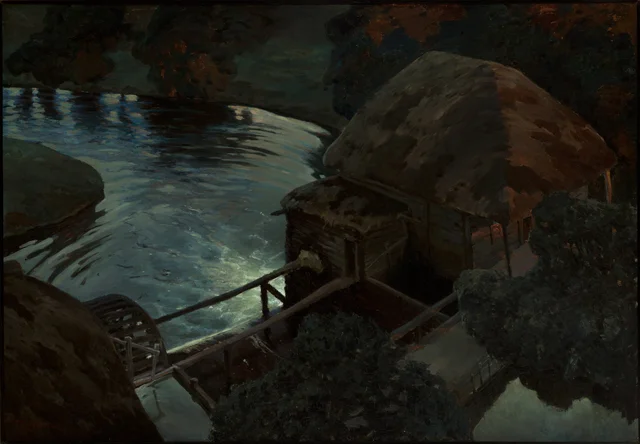
He painted the northern countryside with real feeling for its seasons and weather, half real landscape and half fairy tale. Later he more or less gave up painting to teach and organise, settling in Vilnius, where he rebuilt the university's art faculty and designed theatre sets and festivals. He died there in 1936.