Fernand Cormon
1845–1924 · France · Academic art
The story
In the mid-1880s a Paris teaching studio on the slope of Montmartre held, at the same time, Vincent van Gogh, Henri de Toulouse-Lautrec, Émile Bernard and Louis Anquetin. It was the atelier of Fernand Cormon, and the irony of his career is that the young men who made his classroom famous spent their time there quietly rebelling against everything he stood for.
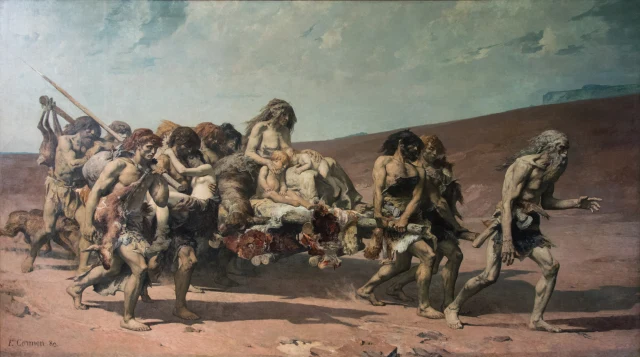
Cormon himself was a pillar of the official art world. His large canvas Cain, shown at the Salon in 1880, imagines the biblical outcast trudging across a prehistoric landscape with his ragged clan. It won a top medal and was bought by the French state. He specialised in these scenes of early humanity and distant history, painted big and carefully in the academic manner.
As a teacher he was more tolerant than his own pictures suggest, and his open studio drew ambitious young painters from across Europe. They came for his name and his connections, then drifted off toward Impressionism and what lay beyond it. Cormon kept working in his own vein for decades and painted decorative cycles for public buildings in Paris, dying there in 1924.