Filippo Carcano
1840–1914 · Kingdom of Lombardy–Venetia, Kingdom of Italy · Realism
The story
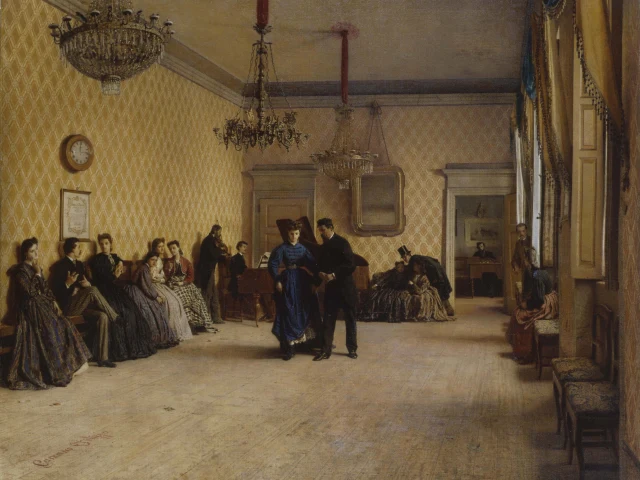
When Filippo Carcano showed A Game of Billiards at the Brera exhibitions in Milan, the picture caused an uproar, partly for its blunt realism and partly for its unusual colour. Later critics saw in its broken touches an early, intuitive step toward Divisionism. Carcano had trained at Brera under Francesco Hayez, the senior master of Romantic history painting, and Hayez's reservations about his pupil's new direction helped shut him out of the official Italian market, so for years his pictures went mostly to private collectors in Britain and America.
The son of a modest haberdasher, he was born in Milan in 1840 and began with history subjects in Hayez's manner, among them Frederick Barbarossa and Henry the Lion at Chiavenna, which won a prize at Brera in 1862. Around 1880 he turned mainly to landscape: the Lombard plain, the Alps and their glaciers, the Venetian lagoon, often finished in the studio from notes made outdoors with tools of his own choosing, such as a long-handled brush and a spatula with a saw-toothed edge. The Venice Biennale showed 20 of his works in 1910 and 45 in 1912. He died in Milan in January 1914, only 24 hours after his wife, Anna Brusadelli.