Floris van Dyck
1575–1651 · Dutch Republic · Dutch Golden Age, Still life painting
The story
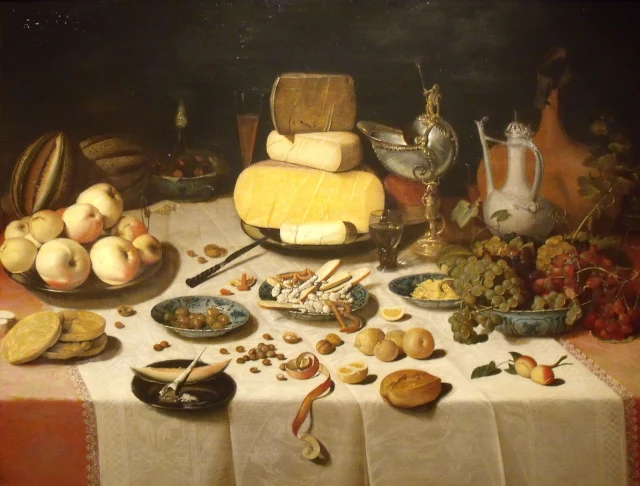
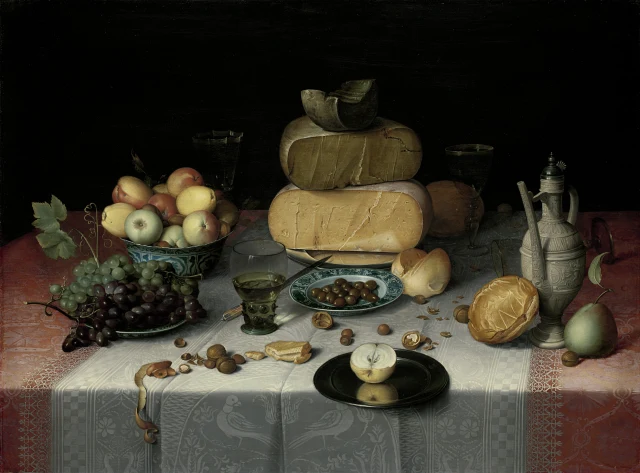
In Haarlem around 1615, a visitor standing before one of Floris van Dijck's panels could feel that the pewter plate was about to slide off the table into their hands. That effect is what he is remembered for. He painted a laid table seen from slightly above, with every object kept clear of its neighbour. In the Rijksmuseum's Still Life with Cheese, a tall stack of cheeses rises from a plate among bread, olives, fruit and wine on layered damask cloths. Theodorus Schrevelius, a Haarlem historian, later wrote that his brush could lure eager women and even the birds.
Van Dijck was born in Delft around 1575 and spent his early years as a painter in Rome, where he knew Giuseppe Cesari, the fashionable painter called the Cavaliere d'Arpino. Back in Haarlem, he passed on news of the Italian painters to Karel van Mander, the Flemish writer compiling his book of artists' lives. He joined the Guild of St Luke, the city's painters' guild, in 1610 and later served as its dean.
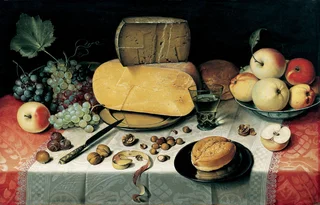
Only about 14 of his paintings are known today. Almost all of them are built around that same stack of cheese, and younger Haarlem still-life painters such as Pieter Claesz took up his arrangement of the laid table. A second marriage in the 1620s, to the well-off Cornelia Vlasmans, may have meant he no longer needed to paint for a living. His largest surviving picture, a banquet still life dated 1622 with Chinese porcelain bowls and a gilded nautilus cup, was bought by the National Gallery in London in 2025.