Francesco Pesellino
1422–1457 · Republic of Florence · Italian Renaissance, Early Renaissance
The story
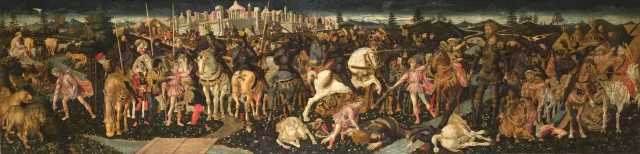
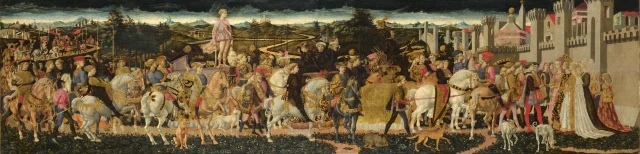
In the 1440s Florence was crowded with painters, and Francesco di Stefano, whom everyone called Pesellino after his grandfather Pesello, was among the most admired of the young ones. He painted small, jewel-like panels, the fronts of marriage chests and the little narrative strips called predellas, scenes packed with tiny figures and gold.
In 1455 he finally won a large public commission, an altarpiece for the church of Santa Trinità in Pistoia, a town near Florence. It was his chance to work at full scale, and he never finished it. By July 1457 he was too ill to paint, and within weeks he was dead, only about 35. The panel passed to Fra Filippo Lippi, the leading Florentine master of the day, whose workshop completed it.
For centuries Pesellino stayed half-forgotten, his hand confused with Lippi's and with others. The altarpiece, long ago cut apart and scattered, was slowly reassembled by the National Gallery in London, which in 2023 gave him his first solo exhibition, a whole career pieced back together for a painter who had less than 20 years to make one. The central panel still shows the seam, the Trinity he began and the saints his successors carried to the end.