Francisco Herrera the Younger
1627–1685 · Spain · Baroque, Spanish Baroque, Spanish Golden Age
The story
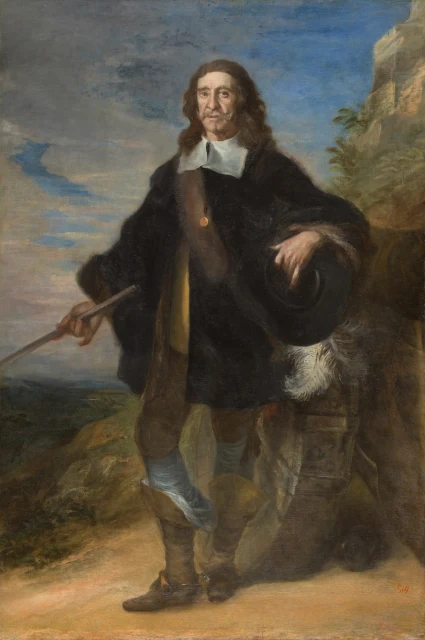
For more than a century the Prado hung this tall portrait of an artillery commander under another name, Francisco Rizi, a Madrid court painter. In 2023, preparing its first survey of Herrera the Younger, the museum moved the picture to him, and the evidence came from the canvas itself. It was cut from the same bolt of cloth as his Saint Peter for the Augustinian Recollects, a friars' house in Madrid, and the brushwork was checked under infrared and ultraviolet light. The sitter leans on a gun carriage with cannonballs at his feet, and the museum's own title keeps a question mark over him: he may be Diego de Quiroga Fajardo, a knight of the Spanish military order of Calatrava who served in Naples, and the identification is not settled.
Herrera el Mozo, as the Prado writes his name, learned to paint in Seville in the workshop of his father, Francisco Herrera the Elder, a man said to have driven his own pupils out of the studio. The son left for Rome around 1648 and made his living there on still life, painting fish so well that Italians knew him as lo Spagnolo dei pesci, the Spaniard of the fish. He came home with full Roman Baroque in his luggage, turned to altarpieces and church ceilings, and in January 1660 was among the founders of Seville's academy of painting, sharing its presidency with Murillo, the leading painter in the city.
Then Madrid, and a second career few painters have had. Charles II of Spain made him a court painter in 1672, and in 1677 maestro mayor of the royal works, the crown's chief architect. In 1680 he travelled to Zaragoza to direct the rebuilding of El Pilar, the city's great pilgrimage church, to his own drawings, and stayed nearly two years. He died in Madrid in 1685 still holding the architect's post, and the ceilings he had frescoed in Madrid churches came down later with the buildings.