Francisco Rizi
1614–1685 · Spain · Baroque, Spanish Golden Age
The story
Francisco Rizi was born in Madrid in 1614 to an Italian father, a painter from Ancona who had come to Spain to help decorate the royal monastery of El Escorial. The son stayed at the centre of Spanish court art for most of his life, becoming a painter to King Philip IV in 1656.
Much of that court work was theatrical in the literal sense. Rizi designed stage sets, festival decorations and the temporary architecture thrown up for royal entries and church ceremonies, the kind of grand, short-lived spectacle a Baroque court ran on. That eye for staged crowds served him well in his most remarkable surviving picture.
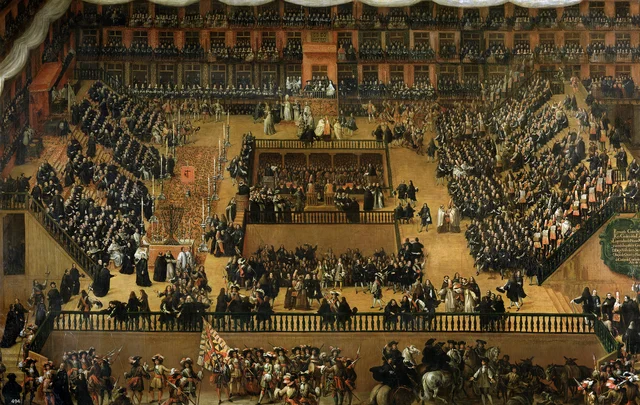
On 30 June 1680 the young King Charles II presided over a great auto-da-fe, a public sentencing of people the Inquisition had condemned, in the main square of Madrid. Rizi was there and painted it, filling a wide canvas with the tiered scaffolds, the crowd and the ordered ranks of the court. It hangs in the Prado now, the fullest picture we have of one of those days.