François Pompon
1855–1933 · France · Art Deco
The story
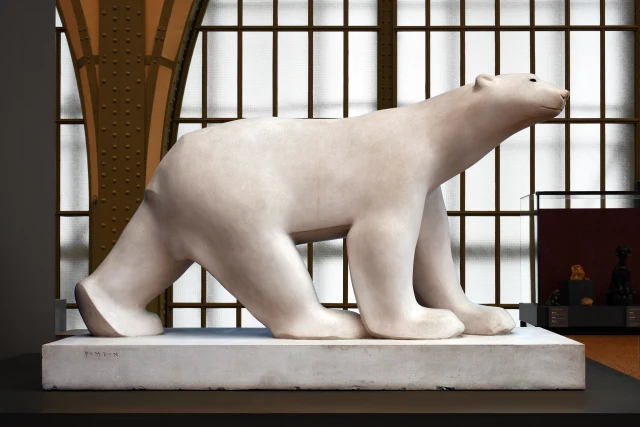
In the autumn of 1922, visitors to the Salon d'Automne, the big Paris show of new art, came upon a life-size plaster polar bear. It had no fur and hardly any claws, only a smooth white body stepping forward with its head held low. The sculptor was François Pompon, and he was 67 years old.
Until then he had spent most of his working life carving other people's ideas. The son of a cabinetmaker from Saulieu in Burgundy, he trained as a marble cutter and became a praticien, the craftsman who turns a sculptor's clay model into stone. He cut marble for the academic sculptors Antonin Mercié and Alexandre Falguière, and in 1890 he joined the studio of Auguste Rodin, where from 1893 he ran the workshop, paying for the marble and supervising the carvers. He also worked for Camille Claudel, Rodin's pupil and partner.
Around 1905 he decided to sculpt only animals, which he watched at the Jardin des Plantes, the Paris botanical garden with its small zoo. He polished the surfaces and dropped the details, so that an animal could be recognised by its outline and its movement alone. In 1927 the French State ordered the bear carved in stone, and that version, about two and a half metres long, now stands in the Musée d'Orsay.
Pompon died in Paris in 1933 and was buried in Saulieu, beneath a bronze condor of his own, and the town's museum now carries his name.