Franz Joseph Spiegler
1691–1757 · Holy Roman Empire · Baroque, Rococo
The story
Franz Joseph Spiegler's great work is overhead, on the vaults of the church at Zwiefalten, a Benedictine abbey in Upper Swabia in south-west Germany. He painted there in 1728 and 1729 and again from 1747 to 1753, and the Zwiefalten frescoes are counted as his masterpiece. They belong to a chain of churches and monasteries now linked as the Upper Swabian Baroque Route.
He was born in 1691 in Wangen im Allgäu, a small free imperial city. His father died the following year, and his mother married a painter, Adam Joseph Dollmann, which is how the boy came to art. Around 1710 he trained in Munich with his great-uncle Johann Kaspar Sing, a Bavarian court painter. His frescoes of 1723 to 1725 at Ottobeuren Abbey show the strong influence of Jacopo Amigoni, a Venetian painter then working in southern Germany. For three decades Spiegler moved from commission to commission across Swabia, Lake Constance, the Black Forest and Switzerland.
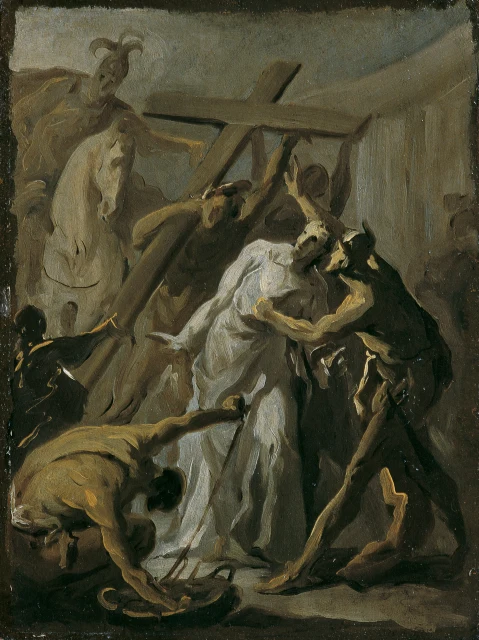
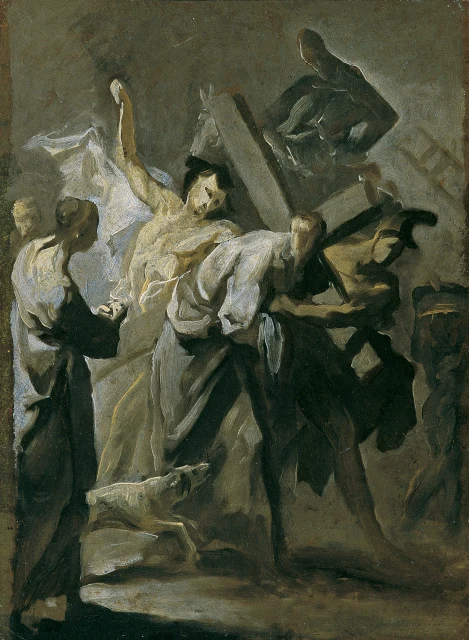
The Belvedere holds two small studies catalogued under his name, painted in oil in shades of grey on paper, showing Christ burdened with the cross and Christ meeting his mother. He died in Konstanz in 1757.