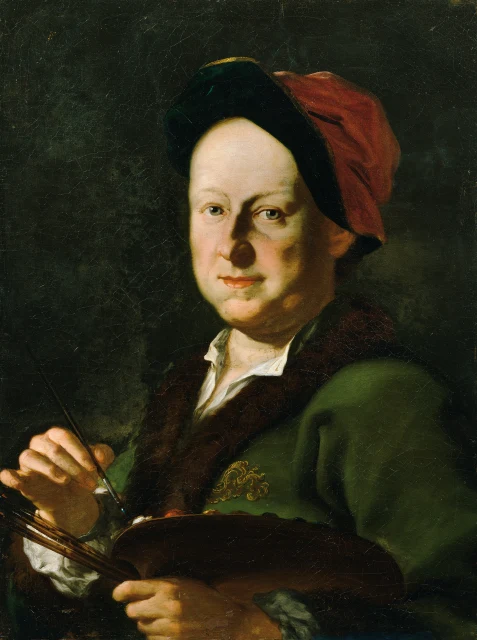
Franz Sebald Unterberger
1706–1776 · Prince-Bishopric of Trent · Baroque, Rococo
The story
The man in this portrait is August Querfurt, a German-born battle painter who settled in Vienna and turned out cavalry skirmishes in the manner of the French painter Bourguignon. The Belvedere dates the canvas, with a question mark, to 1752 and gives it to Franz Sebald Unterberger, a painter from Cavalese in the Fiemme valley of Trentino, who made his career mostly with altarpieces for churches in Tyrol.
Franz Sebald came from a family of painters. His elder brother Michelangelo, who taught him, rose to be rector of the Vienna Academy, and two nephews, Ignaz and Christoph, also became painters. Franz Sebald is said to have taken up painting only at 19. He worked for years in Brixen, largely for the convent of the Poor Clares, visited Venice around 1750 and absorbed the colour of Venetian painters such as Giovanni Battista Pittoni. In 1754 he reportedly spent several months in Vienna, painting a Rosary altarpiece for Brixen Cathedral under his brother's direction, and his chief work is a Saint Elizabeth of 1758 for the Capuchin church in Brixen.
The art historian Nicolò Rasmo judged him the most gifted of the Unterberger painters and the least recognised in his own lifetime. He never married, went back to Cavalese in old age and died in 1776, and 200 years later the city museum of Bolzano marked the anniversary with a large retrospective.