Franz Sigrist the Elder
1727–1803 · Holy Roman Empire · Rococo, Baroque
The story
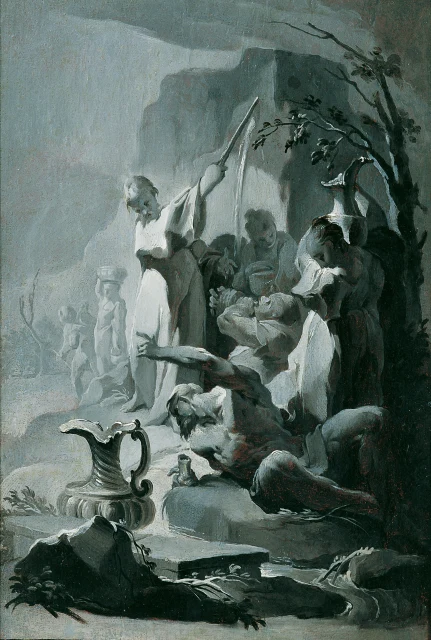
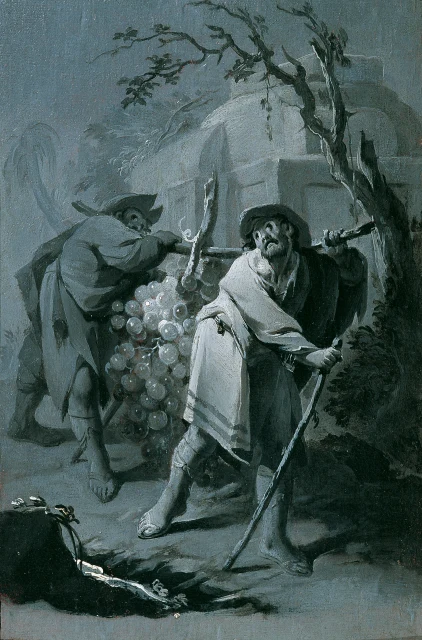
Both of Franz Sigrist's works in the Belvedere are painted in grisaille, in shades of grey only, in oil on paper later mounted on wood. One shows Moses striking water from the rock, the other the scouts of Israel carrying a giant bunch of grapes back from the Promised Land. Sigrist made them in Augsburg around 1755, in the years when he was also drawing more than 100 designs for the engraver and publisher Johann Georg Hertel.
He had come a long way to get there. Born in 1727 in Breisach on the Upper Rhine, then an Austrian town, he went to Vienna at 17 and entered the Imperial Academy in 1744, studying under the fresco painter Paul Troger. From 1754 to 1762 he lived in Augsburg as court painter to the Prince-Bishop, taught at the city's newly founded art academy and painted ceiling frescoes, among them one of 1758 for the monastery church at Zwiefalten in Swabia.
Back in Vienna, from 1764 he worked on a set of six large ceremonial pictures recording the coronation of Archduke Joseph, the future emperor, as King of the Romans in Frankfurt. His best-known surviving work is in Hungary, the ceiling of the great hall of the Lyceum in Eger, painted in 1781 for Bishop Károly Eszterházy and showing the four university faculties of theology, philosophy, law and medicine. He kept painting altar frescoes into his seventies and died in Vienna in 1803.