Friedrich Gauermann
1807–1862 · Austrian Empire · Verism, Romanticism, Landscape painting
The story
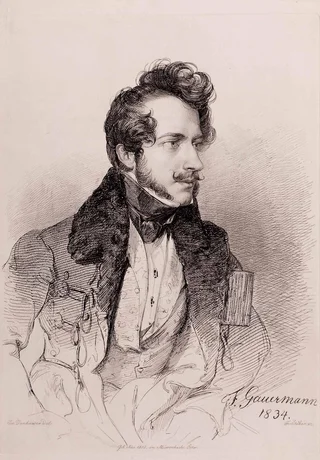
In the Vienna of the 1830s, if a prince wanted a picture of the Alps with a stag in it, he went to Friedrich Gauermann. Metternich, the chancellor of the Austrian Empire, bought from him, and so did the Schwarzenberg and Liechtenstein families, two of the richest houses at court. Gauermann grew up in Miesenbach, a village in the hills of Lower Austria, and learned to paint from his father, a landscape painter and engraver.
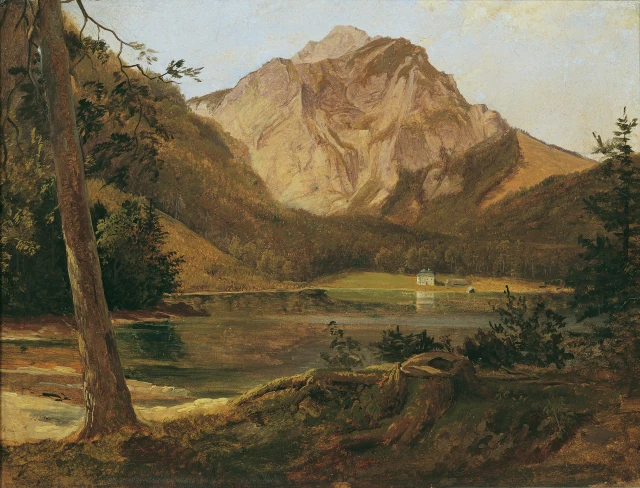
His early pictures were pure landscape, such as the lakes of the Salzkammergut, the lake district east of Salzburg. After a success at the Vienna exhibition of 1830 he began to fill his forests and pastures with animals, and his hunting scenes and animals in combat made his name. A Vulture on a Dead Stag, painted in 1832 and now in the Belvedere, is nearly one and a half metres tall. He studied single animals, trees and streams from nature, then rearranged them in the studio for drama. Cheap lithographs spread his compositions far beyond the people who could afford an oil, and buyers came from England, Russia and Italy.
The revolution of 1848 cost him much of his clientele. His last years were darkened by illness and by the death of his daughter Rosina. When he died in Vienna in 1862, at 54, he left 1,185 oil paintings and 174 drawings, and he was buried in Scheuchenstein, the corner of Miesenbach where he was born.