Gaspar van Wittel
1736 · Dutch Republic · Veduta, Topographical painting
The story
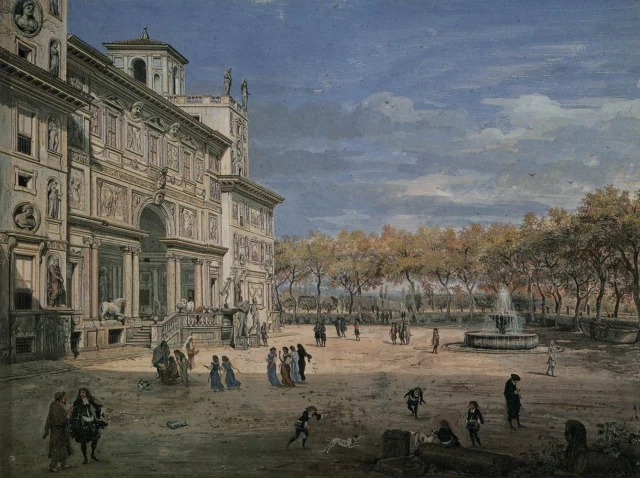
If you have ever admired a crisp, sunlit view of Venice or Rome by Canaletto, you are looking at a tradition a Dutchman started. Gaspar van Wittel was born in Amersfoort in 1652 or 1653 and trained in the careful Dutch habit of drawing exactly what was in front of him. In the mid-1670s he went to Italy, and he stayed for the rest of his life.
In Rome the fashion was to paint the ruins of antiquity. Van Wittel did something plainer and newer: he painted the living city as it actually looked, a real square on a real morning, with its ordinary traffic of people and boats. Italians called him Gaspare Vanvitelli, and this kind of picture got its name, the veduta, or 'view'. He worked out its rules almost by himself, probably with the help of a camera obscura, an optical box that projected the scene onto paper. Tiny distortions at the edges of his canvases, a round church dome pulled slightly oval, give the device away.
His views of Piazza Navona and the banks of the Tiber were bought across Europe, and the young Canaletto saw them on a visit to Rome before turning to city views himself. Van Wittel married in Italy, and his son Luigi, born in 1700, took the Italian name Vanvitelli and became the architect of the vast royal palace at Caserta near Naples.