Georg Friedrich Kersting
1785–1847 · Grand Duchy of Mecklenburg-Schwerin · Biedermeier
The story
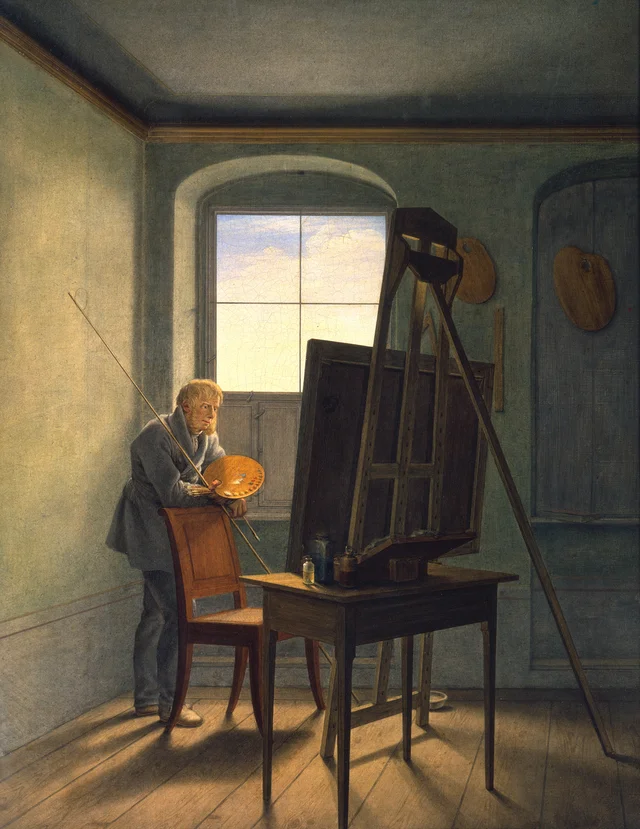
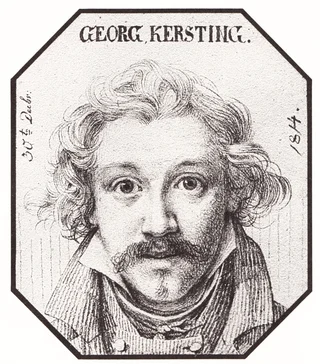
Caspar David Friedrich leans on the back of a chair and stares at a canvas we only ever see from behind. The studio around him is almost bare, with two palettes, a ruler and a T-square on the wall. This portrait of a painter thinking, now in Berlin's Alte Nationalgalerie, is by his friend Georg Friedrich Kersting, a glazier's son from Güstrow in Mecklenburg, who painted Friedrich at work more than once.
Kersting studied at the Copenhagen Academy and moved to Dresden at the end of that decade. Friedrich, a fellow northerner, persuaded him to stay there rather than move on to Italy, and in the summer of 1810 the two walked together through the Sudeten mountains on the Bohemian border. Kersting's own subject became the room. He painted people absorbed in something ordinary, a woman at her embroidery, a man reading by lamplight, often seen from behind in quiet, carefully lit interiors. Such scenes are now counted among the defining images of Biedermeier, the name for German middle-class domestic culture of those decades.
In 1813 he joined the Lützow Free Corps, a volunteer unit fighting Napoleon, alongside the poet Theodor Körner, who was killed that August. Kersting later painted Körner and two comrades in a forest clearing in On Outpost Duty. After a few years as a drawing teacher in Poland, he moved in 1818 to Meissen as head of painting at the porcelain manufactory, and he kept that post until his death in 1847.