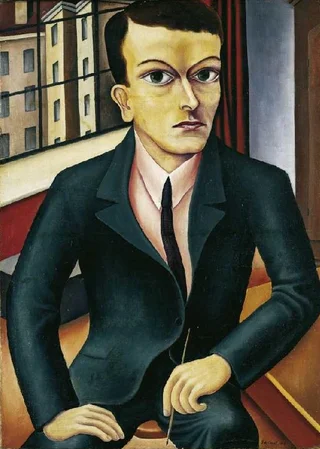
Georg Schrimpf
1889–1938 · Germany · New Objectivity
The story
Georg Schrimpf learned to paint the hard way, almost by accident. Born in Munich in 1889, his father dead before he arrived, he apprenticed as a baker, then spent nearly a decade tramping across Belgium, France, Switzerland and northern Italy, working as a waiter, a baker, a coal-heaver. He did not really begin as an artist until 1915, with no academy behind him.
What he arrived at was a calm, still kind of realism. Schrimpf became one of the central figures of Neue Sachlichkeit, the New Objectivity that came out of Germany in the 1920s as a cool answer to Expressionist heat. Where colleagues like Otto Dix and George Grosz turned that clear-eyed style on the ugliness of Weimar society, Schrimpf pointed it at quiet women, sleeping figures and orderly landscapes that borrow the stillness of early Italian painting.
He had been a radical in 1919, briefly jailed after the collapse of the short-lived Munich Soviet Republic, a socialist government that held Bavaria for weeks. That past, and his gentle unheroic pictures, did not fit the new regime. In 1937 the Nazis threw him out of his Berlin teaching post and listed his work as degenerate. He died the next year, in 1938, at 49.