George Frederic Watts
1817–1904 · United Kingdom of Great Britain and Ireland · Symbolism, Academic art
The story
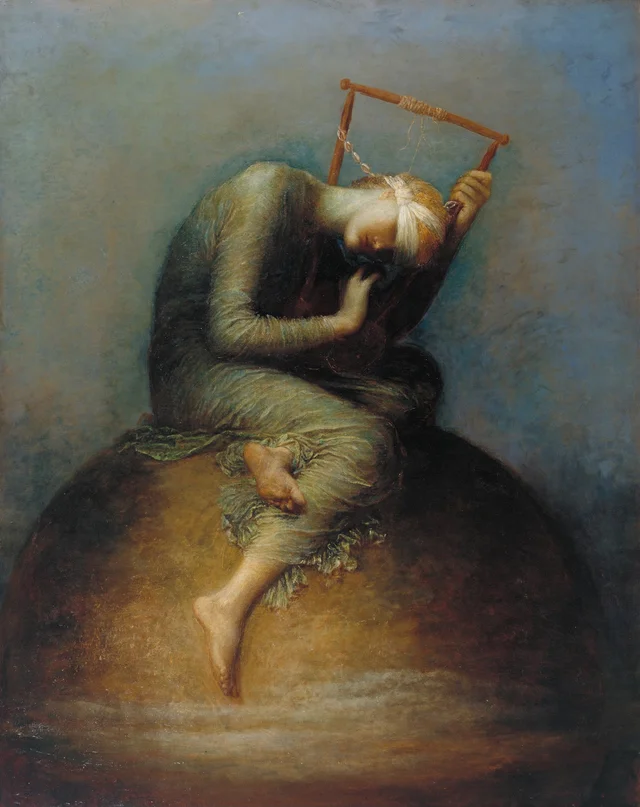
In 1886 George Frederic Watts painted a blindfolded woman perched on top of a globe, bent over a lyre whose strings have almost all snapped, straining to hear the single one still sounding. He called it "Hope", a strange choice of image for the word, and it became one of the most reproduced pictures of the Victorian age, hung as a cheap print in countless homes.
Its life did not end there. A century later an American preacher, Jeremiah Wright, drew on the painting for a sermon he called "The Audacity to Hope", and a young senator who heard it, Barack Obama, borrowed the phrase for a speech and then a book. A Victorian canvas about a nearly broken instrument had travelled a long way.
Watts described his aim plainly: he set out to paint ideas rather than things, and he gave his life to grand allegories of love, death and hope, meant to form a cycle he called the House of Life. He worked as a sculptor too. His bronze horseman "Physical Energy", a rider shading his eyes to scan the horizon, was finished in the last year of his life and still stands in Kensington Gardens in London.